Featured post

What Do High Growth Businesses Do Differently?

Over the past 5 years the importance of the “High Growth Business” and how this relatively small group of businesses disproportionally impa...

Showing posts with label Business. Show all posts

Tuesday, 17 February 2015

Driving Change

As a business leader it is always your responsibility to make sure things happen. When its in the companies and therefore the individual's comfort zone thats pretty easy. Often all it needs is a light hand on the tiller to make sure actions get completed on time.

When it comes to change in the business or the push for further growth then the situation requires a much more robust approach. One of they key messages here is that you set the standard. As the leader, whether you're a unit head or CEO everybody including your leadership team will take their cue from you. So if you are less committed to an outcome than your leadership team members they will default to your position. 
English: Change Management's Approval flow Ita...
English: Change Management's Approval flow Italiano: Change Management, flusso della fase di approvazione (Photo credit: Wikipedia)
To effect change in your business you have to demonstrate you are totally committed. This means that you have to be an extrovert in your commitment to the new position whatever kind of change that might be. The more obvious your commitment, more likely you'll succeed. Whilst this public relations initiative is important, commitment alone wont get the job done. People are creatures of habit and change is unnerving, if you want to see this in action, next time you're at a conference, when you come back from a break sit where another person has sat and just see the looks or comments you get. I see it regularly where neighbours with only "on street parking" start to argue if other people park in "their space".  The bigger the change the more people will resist. To succeed in this endeavour you need a clear process to follow to maximise your chances of success.

Step 1  Do a plan of the change process. 


Plan where you are going and what changes in business practises will be necessary to get you there. As part of that process you will need to identify what you are going to do differently and how that will change what gets measured.  This part is particularly important as it will be these changes in your priorities which will be the source of most concern to your people.

Step 2 Be the First to Commit


You must be the first to commit to the changes. Having identified your new KPI's(key performance indicators) start asking for information that supports your new commitment get people used to the fact that you've changed.

Step 3  Involve Your Leadership Team

Involve Your Leadership Team
(Photo credit: Wikipedia)

This is a two part process, firstly get them together and a group and discuss your plan for change. Take feedback from the group obtain their buy-in for the change process. The second part is to meet each of your leadership team individually and discuss their own commitment to change and re affirm individual buy-in and agree how they will roll it out in their area of responsibility.

Step 4 Set up regular reviews


Use them to discuss progress and address issues where individuals commitment needs to improve. Identify the change blockers within your organisation, and set a course to neutralise them.

Step 5 Drive Change Down Through Your Business


Get your leadership team to adopt a similar approach with their own team, as you have to the leadership team.

This much more likely to deliver a successful change programme as it is driven down through the business. Regular reviews will identify issues  which can be considered and the appropriate solution implemented.  

If you need to achieve significant or rapid change its a good idea to do this through small multiple steps. You see once people make one change, the next becomes easier, the third easier still and suddenly change becomes the new norm. 

To illustrate this let me recount how this was illustrated in a recent workshop I attended. Complete strangers were paired up and the rules were simple, take in turn to make one change about your appearance, the other person then had to identify what the change was. So one person would turn their back whilst the other made a change. Initially the changes were subtle and slow as peoples natural caution to change manifested itself, it was often something like a slight adjustment of a tie or removal of glasses. By the 5th round they were rapid and even outlandish, with jackets, shoes and even shirts were being removed; people had very quickly got comfortable with change.

Change still requires significant effort but the more frequently you pursue it the easier it gets.


Exigent Consulting provides specialist services for Managing High GrowthBusiness Turnaround, and Mentoring to the Small and Medium Business. We help business owners improve the profit performance of their business. 


Monday, 15 December 2014

Is This the Worlds Worst Sales Qualification Question?

Over recent weeks I've seen many businesses fall into this trap and rely on what I think is the world worst sales qualification question. It seems to be especially prevalent in micro businesses and in the creative industries.

In my opinion sales qualification is one of the most important aspects of closing sales. Unfortunately these days most experts seem to concentrate on closing, however proper sales qualification makes sales closing easier. Good sales qualification will help you identify early in the sales cycle those prospects most likely to commit to buy from you, and at the same time help you shorten the sales cycle. Something that we all want. Poor sales qualification, by contrast, results in the opposite leading to a lot of wasted effort and fewer sales.
English: Priit Narusk in the qualification for...
 Priit Narusk in the qualification for the Tour de Ski in Prague.  (Photo credit: Wikipedia)

As we come out of our sluggish economy the number of sales opportunities increases as potential buyers prepare to invest. As providers of products and services we enjoy more sales conversations unfortunately this new found wealth of prospects is ruined by one single question which kills time and is our own work creation scheme. On the face of it this question seems quite sensible and for the inexperienced sales person a good one. Nothing can be further from the truth. 

The culprit for this colossal waste of time the question "Can I write you a proposal".

Why? The answer to this question is almost invariably "yes" so off you go thinking that you’ve progressed the sale because they want you to write a proposal. In reality you've done no such thing. Ask anyone if you can write them a proposal, ask your mates, your competition even the bloke on the corner, they'll all say yes because that question means nothing. Knock yourself out, write me a proposal, in fact send me three because that question commits me to absolutely nothing but creates a whole lot of work for you. What you have really asked me for is my permission to let you rush off and write something, so why I shouldn’t say yes? It has not tested in any way at all, my desire to purchase from you.

The result from his single question is many fruitless hours putting together proposals in which your potential buyers have absolutely Zero interest. That's why its such a poor question.

If you can't resist asking this question, then at least have a good follow up question. This follow up question will help you stop becoming a work creation scheme. It goes like this "Thanks for allowing me to provide you with a proposal, can we arrange a short meeting in a couple weeks time to review it"? If and only if they agree to that meeting is it worth your while writing them a proposal.

The next time you are tempted to ask a prospect "Can I write you a proposal?" remember on its own it’s probably the worlds’ worst sales qualification question. So don't waste your or your sales teams’ time pointlessly knocking out proposals, get a commitment from your prospect first.


Exigent Consulting provides specialist services for Managing High GrowthBusiness Turnaround, and Mentoring to the Small and Medium Business. We help business owners improve the profit performance of their business. 


Monday, 10 February 2014

Time To Review Your Value Proposition.

We can at last say with some confidence that we are seeing some "green shoots of recovery". Recent figures have indicated an acceleration in growth and this points towards a more buoyant economy. Let's not get carried away as we are still operating at levels below the pre 2008 crash. Nevertheless, the supply side of the economy is optimistic that interest in its products and services and hopefully sales will increase next year, as potential  buyers at last dip into their cash hoardings and start investing in their businesses.

A direct consequence of this improvement in sentiment is that many companies will gear up their sales machines in anticipation of improved demand. Collectively that means increased competition for sales.

Also, as buyers start to loosen the purse strings, their years in a very tight market will have changed their perceptions of what is important to them and their expectations of their suppliers and their solutions. This means that your product or service may no longer fit the market as well as it once did. As a result the value you bring to your market may be reduced resulting in a poorer take up of your services and offering your competitors a chance to get ahead.
Identifying your Unique Value Proposition
Identifying your Unique Value Proposition (Photo credit: Intern. Forum Of Visual Practitioners ifvp.org)

New entrants into the market will also be seeking ways to differentiate their product to better reflect buyers changing needs. All these pressures should lead you to the conclusion that you need to review your value. More explicitly you should be reconsidering your value proposition and testing its relevance to a changing market.

Your Value Proposition

Your value proposition is a short statement which explains to your target audience what problem you solve and why they should buy it from you instead of your competition. What is different about your solution or offering compared to your competition. It is sometimes called an elevator pitch or positioning statement. However you want to describe it, now is the time to give it a review.

It's easy to become a little blasé about your value proposition after all you know and love your product. Your target market doesn't have the same attachment and will go after what they want and will not hesitate to ignore you if you no longer meet their needs.

I remember listening to an interview with Jack Nicklaus where he said every year at the beginning of the golf season he would go to his coach and go through the basics of his grip, his stance and his swing in minute detail to make sure that he hadn't picked up any bad habits that might affect his future performance.  Taking that analogy forward we should regularly review our value proposition to ensure its relevance.

Your Value Proposition Components

Lets just remind ourselves what should be included in our value proposition.

What is our target market? Has this changed? Is our market bigger or smaller than before?

What is the current problem we are solving for our target market? Is it an important consideration for customers in our market? For those of you who don’t have a formal value proposition, start with the biggest issue customers have with your industry and see if you address this. If your product or solution is less important to your market than previously, then you’ll have a tough time selling it.

What are we offering? Is it a new product or service? Can we explain it easily?

What is different about our solution? At this point many people talk about a unique selling point. For most businesses finding something that is unique is almost impossible. What you want to isolate is what you do differently or what additional capability you have, that will make them buy from you rather than your competition.

Which brings me to the last point what alternatives are there to what you offer? Why is your offering superior to the competitions? What is the Return on Investment from adopting your solution?

By asking yourselves these questions you should get a good understanding of changes in the market and how that might affect your value proposition. You may be affected by such things as changes in legislation, new products entering the market or your industry being more interested in other problems. Unless you answer these questions, you may well find your value proposition increasingly irrelevant at a time when your target market will be more active than it has been for years.

Exigent Consulting provides specialist services to the Small and Medium Business including Managing High GrowthBusiness Turnaround, and Mentoring. We help business owners improve the profit performance of their business. 


Friday, 8 November 2013

The High Growth Challenge

  If you haven't been to my blog before you might want to subscribe to my feed

Growing a business is a challenge in its own right, growing a business in an environment of  high growth is doubly difficult. To get an idea of just how difficult that is you only have to look at how few businesses manage to sustain high growth (20%pa) over say 4 years; and what a tiny percentage of those will achieve this state for a decade. So be under no illusion  sustaining high growth is a major challenge.

So what makes it so difficult? It is my contention that too many businesses focus on the wrong issue. In any business there are two basic components that need to grow together sales and the organisation. Sales is the easy bit. OK so thats a bit of an oversimplification. Growing sales is tough, how tough, depends to a significant degree on market growth. It is self evident that its harder to achieve high growth in a slow growing or even stagnant market compared to a market which is also in high growth. Some might even say that growing at 35% when your market is growing at 50% is actually under-performing. However too many so called growth experts focus on sales and marketing because thats the key driver. Absolutely true. What sustains high growth, however, is matching organisational growth to support sales growth and thats a whole different order of difficult.

Why is it so difficult? Firstly, because it involves managing multiple disciplines successfully not just one. Further these different functions have to, as far as possible, be kept in balance along the way. In addition the matching of organisation to sales has to be close enough to allow the business to make a profit sufficient to allow it to reinvest in maintaining growth. This is because for the most part businesses have to rely on their own cash generation to fund growth. There businesses that generate extra ordinary growth but this usually only possible because they have access to extra ordinary amounts of cash. Those cases aside it's up to the business owner to fund his own growth.

English: Hammer thrower Mike Mai practices at ...
English: Hammer thrower Mike Mai practices at Fort Lewis, July 1. (Photo credit: Wikipedia)
To illustrate this in a different way, let's use the analogy of a hammer thrower. At its basics you pick up the hammer rotate across the circle and hurl it into the distance. In reality it is a very technically demanding sport. The key to success is to remain in control even though your rotate faster and faster across the circle before launching the hammer into the distance. In order to be successful the hammer thrower needs to stay ahead of the hammer. This means that the hammer stays slightly behind the throwers rotation so that they retain control. If however the hammer gets ahead of the thrower then control switches immediately from the thrower to the hammer as they are in effect being pulled around by the hammer. The result is that the subsequent throw is out of control and either it crashes into the side netting or if by chance it does make the opening it has no great distance or direction. The problem for the hammer thrower is that if the hammer gets ahead of him it is impossible to slow the ball down a little bit to get back in control. Slowing down inevitably results in sufficient loss of momentum for the hammer to just falls to the ground. If we read sales growth for the hammer and organisational growth for the thrower we can see that if organisational growth falls behind sales growth the only way for the position to correct itself is for sales growth to slow. The problem is, that like the hammer falling to the floor, sales growth tends to stall completely.

7 principles of Managing High GrowthThis common occurrence is evidenced by what I call "shooting star" businesses that shine brightly, for a brief time  then disappear. These are businesses that grow very rapidly for a year or so but then the wheels come off management spends the next year to 18 months clearing up the mess. Significantly this experience is so painful that the business often makes a conscious decision to avoid high growth in the future.

Secondly, it requires a very broad range of business knowledge and expertise. Its something that few business owners are aware of, especially in the early stages when often they are struggling to make the mind shift from being an exponent of what they do to being the MD of a business that provides those products or services  Even if they are aware of it few business owners have thought about managing the impact of growth or assessing the interconnections between functions which accentuate both good and bad decisions. I've put them into seven areas. They are:

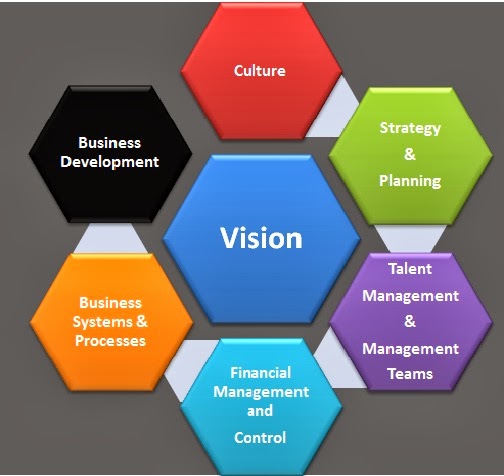
Vision, Culture, Strategy and Planning, Talent Management, Financial Management & Control, Business Processes and Business Development. The first are about leadership and infrastructure. The other 5 look at key business activities but will be much more effective if the infrastructure is in place. 

The challenge for a business in maintaining high growth is to grow the organisation consistently over time to match sales. In supporting businesses to understand and undertake this challenge in a knowledgeable way we are much more like to provide sustainable high growth businesses. 

Exigent Consulting provides specialist services to the Small and Medium Business including Managing High GrowthBusiness Turnaround, and Mentoring. We help business owners improve the profit performance of their business. 


Friday, 6 September 2013

Good Culture and Return On Investment


There has been a lot in the press and blogosphere recently about how its people that matter in providing a competitive advantage to a business. In a recent discussion with a number of  high growth companies, whilst there was a general acceptance that people and more specifically Culture mattered; there was a mixture of both skepticism and confusion about how one might quantify the benefits. 
Good Cuture
Buddhist Flags Tibet

I went away to think about how I could use simple recognisable examples to demonstrate the economic value of "good" culture over a "bad" culture. 

Lets take two examples. The first is a company which might be described as having a bad culture or perhaps a culture where the employees don't feel engaged or committed to the business. I expect we can all recognise similar companies.

In this business employees turn up for work between 8 and 9 am but do not voluntarily start their work and continue to read their newspapers or use their smartphones until 9am. During the working day they stick religiously to the rules having 15 mins break in the morning and having their 1 hour lunch break. At the end of the day to make sure they can leave at 5pm exactly, consequently work winds down around 4:45 and everything is put away, necessary ablutions done in time for a mass exit at 5pm.

In the second business where they have a "good" culture staff arrive between 8 and 9am and mostly start their working day when they arrive, whilst everyone takes a lunch break many can be found back at their desks working resulting in them having substantially less than the mandatory hour. When 5pm arrives most of the staff are still working and they gradually drift away from work over the next  hour.

So its easy to see that on average people in the company with a "good" culture or where they are engaged with the organisation work longer. For the sake of this example lets assume that on average the "good" culture business get 30 minutes more per day per employee than the business with a "bad" culture. Based on my everyday example I don't think that's an unreasonable estimate to make.

Over a week that's 2.5 hours per employee on the basis that an employee works 46 weeks a year, excluding holiday entitlement and public holidays, that equates to 115 hours per employee per year or if you prefer about 16.5 days.   

For a company with 10 employees that's 165 extra free days work or 33 man weeks. That about 3/4 of a full time employee every year for a 50 man company that's 3.5 man years of effort extra.

So what does that mean in financial terms. That's a bit more difficult to quantify because were are going to have to make some assumptions about average pay across the business. Using composite rate of £10 an hour, which I suspect is a little conservative but makes the maths easier, we get an economic benefit of about £1150 per employee per year. For our 10 man company that £11500 per year. For our 50 man company that's £57500 comfortably more than a couple of employees. If we assume the businesses are in aerospace, IT or other high skilled industries the financial benefit increases dramatically because the average hourly rate is probably closer to £25 than £10.

So what have we discovered? Firstly I would say small differences matter 30 minutes a day isn't much spread across employees but it adds up to a significant extra saving and competitive edge. Secondly, in keeping this example as simple as possible we have ignored a number of other benefits including the fact that people work harder and more effectively when they are happy at work. They don't "clock watch", they operate better as a team. All these additional factors increase productivity and performance. They are however very difficult to quantify and certainly not without an organised an scientific study which is way beyond my capabilities. 

Nevertheless I think it has been possible to demonstrate clearly that there is a quantifiable benefit to having a "good" culture and even on this anecdotal basis its financial benefits are not to be ignored.


Monday, 12 August 2013

Does Your Website Pass the "I" "We" "You" Test?


  If you haven't been to my blog before you might want to subscribe to my feed

Two Perspectives - Yours and the readers, chose the readers.
Two-Point Perspective. Write from the readers perspective on your website. (Photo credit: Wikipedia)
As the use of websites to promote our brand and generate leads intensifies too many of us fail a basic but critical test which dramatically impact the performance of our sites.

You will know by now that Google wants everyone to focus on content, yes, that’s the boring bit we have to produce which goes on those lovely well designed web pages we've paid for. For most of us writing copy is not something we do as a profession, but there is something simple we can do which will help us connect with your audience even if we aren’t confident about writing copy.

The most influential is the "I" "we" "you" test. What does that mean? This is simply the number of times you use the terms "I", "we", or "you" on a single page of text. The ideal ratio is 1 "I" "we" to every 6 "you". Sadly for most web sites the ratio is the complete opposite. Why is this important? As a visitor to a site I want to you to be writing from my perspective about thing of interest or benefit to me and about things that might or should be important to me. Its a basic marketing principle that you should always write from the prospective of the reader not the writer. The reason for this is simple when we write from our own perspective we get to focused on what is important to us, which in most cases is not what is important to the reader.

For example writing on your web site “we’ve been established for 25 years and we offer the best in class widget, our quality makes us different” Well lovely, but frankly I’m just not that bothered. However, if you wrote “As a user of widgets you've probably found that the biggest problem is inconsistent quality. So you’ll be looking for a supplier who can give you guarantees about the performance of the widgets you need”. Well you know what; I’m interested.

The two short extracts are talking about the same thing but from a completely different perspectives and it’s the latter which employs “you” that speaks from a potential purchasers perspective which engages the reader, and that is the perspective you must have to get the maximum performance from your site.

Now then why don’t you nip over to your website and see how you fair in the "I" "we" "you" test.

Exigent Consulting provides specialist services for High Growth BusinessesBusiness Turnaround, and Mentoring to the Small and Medium Business. We help business owners improve the profit performance of their business. 


Thursday, 6 June 2013

Exploiting Your IP For Commercial Advantage

There were a couple times over the last week when I have bumped into Intellectual Property (IP), the first was that there are tax breaks if you exploit it and second IP is still hugely valuable even if you cant patent it. Both occasions incidentally were through group discussions on LinkedIn.
Graph showing European patent applications fil...
Graph showing European patent applications filed and patents granted from 1997 to 2008. (Photo credit: Wikipedia)

My first instance was a post in my own Linked In group about the "Patent Box" which was a UK tax incentive come concession which over the next 5 years will enable businesses to claim corporation tax of 10% for that portion of the business based on patents. I'm a little fuzzy on the detail but true to form there was virtually no publicity around this change in tax breaks which is clearly designed to start to change the culture of British enterprises to recognise the commercial value of IP.  If you are a manufacturing, engineering or high tech business, what are you doing to protect your IP? Could you protect your business assets by patenting your new ideas?

Now there is often a basic misunderstanding of what is patentable. It doesn't have to be new, but a idea of a product has to demonstrate that the components have been put together in a novel way to provide a unique solution to a and existing problem or using known components in a way that solves a completely different problem to that originally envisaged.

Image representing iPad as depicted in CrunchBase
Image via CrunchBase
Many of you will recall that Apple recently went to court over their patent on the slide control for the iPad and iPhone. Making that control isn't new other than the idea to use it for power up and power off, yet it is patentable.

The importance for a company is that IP offers some protection for their ideas and will stop competitors freely stripping down your product and blatantly copying it. In the longer term having patents will add value to your business enabling you to get a better price on exit that you would without them. The degree of additional value obviously depends on the patents you hold.

Lots of ideas and development of existing products could be protected by patents but the engineering and RandD functions seldom tend to connect the idea with commercial value as innovation is just what they do. As a business owner it is up to you exploit the commercial advantage of holding patents. Yes, there is a cost but a simple ROI analysis will tell if its worth it. Additionally good internal practices can significantly reduce the cost of getting a patent by doing a lot of the basic work before it ever gets to a patent lawyer. 

The other area of IP is that which is not patentable but still delivers great commercial advantage. This IP is typically about how we go about performing our business. Its more about ideas and business processes which enables you to be seen to be offering an advantage over your competition.

The importance of IP to high growth businessesGoing back to my time with Admiral Computing we had IP in our estimating process which enabled us to use metrics to accurately estimate projects and importantly as part of the sales process we would give a detailed copy to the prospect which explained how we had reached our price. We would always say "if you can find a mistake in our estimates we will certainly change them but we consider that this detail will demonstrate why our estimate is what it is". 

We were very seldom the cheapest but we were nearly always the only one who could quantify our estimate.  This led the customer to understand that our price and certainly our effort was an accurate measure of what was required. 

As they had more confidence in our numbers we were selected as a low risk option and in the vast majority of cases they were proved right as we came in on time and to budget.  

My experience is that a high proportion of high growth businesses have this kind of IP and find a way to exploit it to their commercial advantage. 

If you are the business owner do you know what ideas and processes you have that might give you a competitive advantage and what are you doing about?

Exigent Consulting provides specialist services to the Small and Medium Business including Managing High GrowthBusiness Turnaround, and Mentoring. We help business owners improve the profit performance of their business. 


Friday, 17 May 2013

Eight Tips for Small Business Owners


This month I have a guest blog from a writer at Nerdwallet. Since I have so many US readers I thought It might be nice for you to get a more local view of the issues surrounding Small Business. Having said that Angie provide some useful common sense advice that is valuable to any small business; especially those who are about to, or have just started as business owners.


"Let’s be honest, owning a small business nowadays is challenging. There are so many things to keep in mind, and as such, many variables to consider. It can get a bit flustering trying to sort out every piece of advice you hear. Let’s look at eight solid guidelines that should be staples of any small business owner’s, “things to remember” list.

1. Save up as much money as you can before starting.

One of the worst mistakes you can make is going into business with no capital saved up. Relying on loans from the bank, the SBA or friends is a great way to get you into debt. What some small business owners don’t realize is that it can take awhile for your business to start providing enough profit for you to pay the loan(s) back. If you business isn’t as profitable as expected your lender might just call in the loan, or you may have to pay it off with your credit card. Save enough to cover yourself for at least a year after you start your business.

2. Minimize costs.

Calculate out how much everything is going to cost you. Find how out how little you could possibly spend, and still be effective. Don’t rent out more space than you need, or hire more employees than you will need. You want to start small and keep your screw-ups small too. Give yourself time to learn and deduce the best way to go about things, before you shell out too much cash on this or that. It will save you money in the long run. 

3. Safeguard your personal assets.

You must understand that once you start a business, you are liable for all debts and judgments that it incurs. This can include any judgments from lawsuits against your business, taxes, loans, or money owed to renters. To protect yourself from having your personal assets seized, you will want to get business liability insurance. This alone will not cover you against everything however, and you may want to consider forming a limited liability company.

4. Know how your business will be making a profit

You are going to want to crunch the numbers, analyze the data, and come up with a figure of how much you will be making, how much of it will be going back into the business, and how much actual profit you will be earning. Don’t forget to factor in all the costs of running your business, and figure out how much product you will need to sell.

5. Find your competitive edge and use it

Not every small business is successful, the ones who are doing things that nobody else is, or doing them better than anybody else is, are the ones who make the profit. Whether it’s a special marketing technique, survey method, or manufacturing short cut, find something you can use that nobody else is. You either have to have higher quality than your competitors, or be smarter than them. Once you find this competitive edge, it’s important to guard it. Don’t let anybody find out your secret to success, because it won’t be a secret anymore.

6. Put everything in writing

Oral agreements or deals made over handshakes are not reliable nowadays and it’s wise to put everything important in writing. Make a habit of giving and getting receipts for everything. You will need many contracts written up for things including storage agreements, service contracts, and leases. Don’t be the guy in court without any paper evidence of your claims.

7. Acquire quality employees

Hire employees who are both enthusiastic and highly skilled at their job. An enthusiastic employee will make your business environment much more friendly and appealing to customers. You want your employees to represent your company well on and off the job, and this is more likely to happen if your business is respectable. Pay your employees well and treat them with respect, the result will be worth more than the effort.

8. Pay your taxes! 

As a business, you will be responsible for more than just your personal taxes. Especially important to pay on time are your payroll taxes. These can levy heavy fines if not paid on time. Stay up to date on everything you owe, and maybe even pay some bills early once in a while, it will pay off for your reputation.


Angie Picardo is a staff writer for NerdWallet. Her mission is to help consumers stay financially savvy, and save some money with the best online checking account."


Exigent Consulting provides specialist services for Managing High GrowthBusiness Turnaround, and Mentoring to the Small and Medium Business. We help business owners improve the profit performance of their business. 


Monday, 8 April 2013

Finding Your Vision? Why Is It So Difficult?


I was doing some research for a book I am writing, part of which is about the importance of having a vision. What has become clear, especially in the UK, is how little understanding there is about this topic. This was brought more into focus whilst watching the documentary series "The Men Who Built America", what made them stand out was not only the strength of their Vision but the fact that they had one at all.

My experience in the UK with owner businessmen, is that it is quite challenging getting them to understand how important having a vision is to the long term prosperity of their business. When I give training courses about leadership of high growth businesses, the section on Vision is one of the most challenging. This is because I can count on the fingers of one hand how many business owners actually have thought out what their vision is, whilst the majority just dismiss it as some sort of consultant "mumbo jumbo".  They simply don't get it.

English: DOE Departemental Enterprise Vision
English: DOE Departemental Enterprise Vision (Photo credit: Wikipedia)
I wonder if it’s something about the British and their cynicism that prevents them from grasping the value of understanding the purpose of their business. I don't mean from a personal perspective ie to make money, retire in 5 years, those statements are just measurements. I mean having a real business Vision:  something that describes what it is about the way you do what you do, that will have customers flocking to buy your product or service. To paraphrase a comment about George Bush senior and his struggles with the vision thing "If you don't know where you want to go why would you expect others to put themselves out to help you get there?"

That’s essentially the simple great benefit of having a vision. It is something that you can use to bind your employees and your customers to you as they will see, understand and share your Vision and as a result will want to continue to be your customers or employees, to help you get there.

Most of us haven’t found that vision or purpose and so it is much easier to find a substitute and embrace someone else’s, rather than to try to uncover your own. By finding your vision you become one of the few and really separate yourself from your competition. Once found, it immediately makes decisions easier by simply asking does doing this move me towards my vision? You will instantly discard those actions to which the answer is “No”, allowing you to concentrate on those things that will. This immediately makes your business more effective, as you have a clear simple process on which to test effort and separate yourself from those who don’t know where they are going, so, do everything “just in case”

Let’s be honest, uncovering your vision is difficult and getting it down to a succinct phrase takes a lot of effort. Do you really think that the famous Disney vision "to make people happy" came together in a blinding flash? It was developed and honed over time to something that encapsulated the Vision in a simple sound bite. 

Just because we don't generally think at this level or in these terms doesn't mean we can’t if we don't put our minds to it. The first stage is to just put something down and work on it over time until you think it reflects your purpose.

Here are some examples of small business visions, but not small, business visions. I asked the members of the LinkedIn group that I run “managing high growth” if they had a vision and if so what it was. These were the results. I think these examples are more relevant than those famous Visions of the large corporates.

In case you’re asking mine is "To enable high growth businesses to grow faster for longer and with less stress" Others are “To help clients increase sales and reduce time and cost” and “To create an environment where people feel valued”

So uncover your vision and get yourself clarity in your business, separate yourself from your competition and start being more successful. If you think you'd like some more help in extracting your vision contact me here


Exigent Consulting provides specialist services for Managing High GrowthBusiness Turnaround, and Mentoring to the Small and Medium Business. We help business owners improve the profit performance of their business. 


Friday, 8 March 2013

Social Media Stop Fighting it and Start Using it

  If you haven't been to my blog before you might want to subscribe to my feed
English: Infographic on how Social Media are b...
English: Infographic on how Social Media are being used, and how everything is changed by them. (Photo credit: Wikipedia)

Social Media is going to become increasingly important in everyone's lives whether we like it or not. As a business person that means you have to get to grips with it as a means of generating leads.

The reason I say this is not the usual 1 billion users on Facebook or 500 million on Twitter or the growth of LinkedIn or any of the other very many social networks. It's simply a question of demographics. That is the generation that was brought up on this stuff are now entering the workforce and will steadily occupy more senior decision making positions and they will use what they are familiar with to search for and validate suppliers. What immediately comes to mind to them is social media. 

This was brought into sharp focus by a story I heard recently. It's about three partners who each run their own retail outlets. One for men one for women and one for kids. They all bear the same family name although the stores are really separate. A local blogger had been to the children's store and had been unimpressed with the service they had received, and posted a blog about the experience. Other members of the community had posted comments agreeing with the sentiment. 

One of the younger members of staff in another shop had seen the posting and immediately made it known to their boss. His answer was well we run a different shop so its nothing to to with us and we work hard to give a personal service to all our customers. It wasn't until it was pointed out that whilst they the partners new how the shops were organised the public at large didn't. Since they all bore the family name in their title, people would naturally connect the three shops together, and that could lead to potential customers avoiding the other two shops because of bad reviews in the shop for children.

The next problem for the shop owner was that they had no social media foot print at all so it was not obvious how they could counter act these adverse comments. The solution to this problem, as I understand it, has not yet been found.

The issue that this raises is that the younger mums were much more connected to social media than the owner and it also illustrates the problem many older people face; that is because they were not on social media they had no idea that these comment were being made and so could do nothing about them. It also demonstrates that as our customers will get younger this type of interaction will become more common.

Google 貼牌冰箱(Google Refrigerator)
Google 貼牌冰箱(Google Refrigerator) (Photo credit: Aray Chen)
Also for the first time the likes of Google will come under pressure as the enormous amounts of information collected by the social media giants will be used to provide more relevant search results than a general search engine  like Google. That in turn means that these new customers will NOT be using Google to search for what they want. This isn't going to happen over night but it has already started. LinkedIn users can already search for skill sets companies and individuals within their site and recruitment companies are using it to great effect to validate potential candidates. Whilst they might search Google for other information their primary search is through LinkedIn.  It Wont be long before the other networks find a way to exploit their data. This means that having a web site that can be found using Google will no longer be enough, to get yourself found, you will have to be present on some or other social network.

More worryingly perhaps for the older generation is figuring out just how we interact with social media, what do we say how do we say it and which socials media platforms do we use to communicate. The rate of change in this market is still rapid but we learn to get to grips with it otherwise we are going to end up using marketing channels which just don't deliver.

In short we need to get our feet wet. Once you are in then you can educate yourself by watching others and learn how to exploit these channels. It's likely to involve some investment in training but that's a small price to pay to keep your business growing.       

Exigent Consulting provides specialist services for High Growth BusinessesBusiness Turnaround, and Mentoring to the Small and Medium Business. We help business owners improve the profit performance of their business.