Featured post

What Do High Growth Businesses Do Differently?

Over the past 5 years the importance of the “High Growth Business” and how this relatively small group of businesses disproportionally impa...

Showing posts with label culture. Show all posts

Tuesday, 23 August 2016

Four ways to get out of the detail and concentrate on driving growth

One of the biggest issues for a high-growth business owner is learning how to relinquish day-to-day tasks
 so that they can take a more managerial and leadership role. Many businesses live right on the edge of capability and disruption from the slightest unforeseen issues can cause the leadership to fall back into the business detail.

Why?

There are a number of reasons why this happens, the two most common that I come across are:

A failure by the leadership team to understand what their role is. The result being they get involved in everything
Not understanding the difference between a cost and an investment. High-growth companies are profit conscious, but sustainable growth requires proper investment
There are, however, some simple techniques leaders can use to help them avoid these growth limiting issues.

Get out of the detail and concentrate on driving growth1. Fit for purpose, not perfect

When we start a business we do everything, from washing up to board meetings. As the business grows then we learn that we can’t do everything and so we have to give tasks to other people; we delegate.

This in itself can cause a problem. Why? Because as business owners we’re typically overqualified to do the jobs we’re delegating, which often leads us to have an unrealistic expectation on how certain activities should be performed.

Let me give you an example. A director for a multimillion-pound removal business insisted that he should produce the route planning for his drivers. One day I asked him why he didn’t delegate the task as it was a job that in most businesses would be done by a lower level person. In any case, most of the work was shouldered by the route planning software. His reason was that the people he delegated this job to didn’t do it as well as him. So he saddled himself with a completely unnecessary task for two hours every day.

I went on to ask how much he would expect to pay someone to do the job. ”No more than £25,000,” he said. “And, you pay yourself?” I asked. His reply was “over £100,000 Laurence, and you know that".

“Yes I do,” I said. “So, why are you paying yourself £100,000 to do a job that you’d only pay £25,000 for someone else to do.”

At this point, the penny dropped and he got one of his managers to take over that responsibility. Many times the people who take over a job from you won’t do it as well as you, but they will do it well enough for you not to have to take it back.

2. Question what you are doing

Michael Gerber talks about “getting out of the box”. What he means is, you can’t operate at multiple levels in an organisation at the same time and be effective. For example, you shouldn’t be the sales person, sales manager and sales director. You need to divest yourself of the sales person role before you can properly accept the sales manager role.

My route for achieving this often complicated goal is to ask yourself: “Would I give this task I’m doing to a director of this company?”

From the answers build two lists one under ‘Yes’ and the other under ‘No’.  Next, take the ‘No’ list and start to group tasks into common areas (it’s much easier to do this from a list rather than off the cuff during a busy working day).

In a growing company these tasks won’t add up to a whole person’s job, nevertheless, you may well be able to give these connected tasks to others in your business freeing up valuable time for you to spend on more important activities. Rinse and repeat on a regular basis as your business continues to grow.

3. Give yourself a job description

Write down what your role entails and stick to it. This will prevent you from accumulating lots of other tasks which lower your productivity and eat away at your valuable time.

Review it every six months or so and make any changes necessary, trying always to focus more on strategic tasks.

4. See people as an investment!

Many high-growth businesses are under-resourced. This is often because owners see new hires as a cost. Much of this is because we don’t look at people as an investment in the same way we would machinery or another physical asset.

The issue here is to understand that they are an investment and they can deliver value considerably greater than their salaries. Their greatest benefit is that they give those in the rest of the business time, a commodity that is in desperately short supply in most high-growth businesses.

Here are two examples that illustrate what I mean. A high-growth construction business had been plagued by slow payments, but the owner refused to spend £25,000 on a credit control person because he didn’t want to add to his overheads. When he finally relented, the credit controller reduced outstanding debts by almost £400,000 in their first four weeks, eliminating the company’s cash flow issues.

The sole director of a high-growth services business was being overwhelmed with demands on his time resulting in missed meetings and half completed jobs. After a lot of pressing, he reluctantly agreed to hire a personal assistant. His assistant’s organisational skills transformed his ability to perform by managing demands on his time and controlling his diary. He no longer misses meetings or deadlines.

So, don’t be too afraid to try. Sometimes even the best thought out investments fail, but that doesn’t mean you should stop investing. I do realise the difficulty in saying to someone that they haven’t worked out for you, but hiring people is never perfect and the risk of failure isn’t a good enough reason not to hire at all.

This post was originally published in Businesszone.co.uk in July 2016.


Tuesday, 21 June 2016

What Mike Ashley Has Taught us About High Growth Businesses

Introduction

Successfully managing high growth is hard. We got an insight of just how hard, with recent revelations about Sports Direct from its owner Mike Ashley. Although the sceptical amongst us might consider some of his statements as a bit of window dressing. There is no doubt that recent events have brought into sharp focus just what can happen in a business when High Growth becomes “too much growth”.

Successful High Growth is not merely about growing your customers, but rather being able to deliver the sales that you have won. For many tech companies, it's relatively easy, it simply requires more hardware to support scale. For a more traditional business, things are a bit more complicated. In Sports Directs case it’s about mobilising the supply chain so that when someone buys online, the product can be delivered, which assumes it’s in stock, which means it’s been ordered from the manufacturer, typically in the far east, in time to meet demand. It also assumes that there are sufficient people in the right place to make this happen.

Culture

You’ll recall a number of statements by Ashley to the MP’s select committee about his shock over some of the working practices and the “Culture of Fear”. This rather indicates that the Culture in Sports Direct had gone bad. This is probably because the business had grown so fast that new employees did not buy into the existing company culture and allowing an aberrant form of the Culture to grow. 

This happens because the people who perpetuate and enforce cultural norms are the lowest level of management. It is they who come face to face with new employees and will have to explain why things are done the way they are. It also requires support from the company leadership to underline the importance of the company’s cultural norms.  When these “custodians of the culture” become overwhelmed with new employees the existing culture breaks down. What rises in its place is a culture driven not by company values, but rather by the force of individual personality. 

How easily this happened depends on the strength of the company’s culture in the first place. If it’s not very strong, then you’re pushing at an open door. 

Process

Processes like culture can also break down under the strains of growth. In fact, successful businesses are constantly reviewing processes to maximise performance.

It seems that this idea has been lost on Sports Direct and their processes were not fit for purpose. To be fair some of this is simply a result of just how successful Sports Direct can be. You might recall Ashley saying that on some sunny days, demand can increase by 25%. That puts tremendous pressure on the business to perform. The problem for the company is that it has not separated human processes from fulfilment processes, it has simply failed to recognise that people perform better in a positive environment, bullying and intimidation only work up to a point, but in the longer term people just do enough to get by; meaning that productivity remains stubbornly low. You’ve got to ask yourself how productive some can be when they reach full term of their pregnancy.

What seems clear is that insufficient time has been spent on making these processes perform. 

Leadership


Mike Ashley talked about the business outgrowing him. The more sceptical amongst you might see this as a way of mitigating his failure to lead. The leadership of Sports Direct have been simply unable to get back control of the business. The failures highlighted in their distribution warehouse demonstrate that the Leadership team we unaware of what was going. Now, whilst I accept that in a big organisation, problems like this can arise, what is clear is that this has been a long-term issue and signals a clear failure in leadership. So Mike Ashley might be speaking the truth when he says the business has outgrown him. 

Conclusions

What are the key lessons we can draw from this sorry state of affairs? For a start, never underestimate the negative effect that bad culture has on your business performance. The stronger your Culture, then the faster you can grow without an unacceptable dilution of your cultural values.  Culture starts from the top everyone takes their cue from those more senior to them. If you as a Leadership team don’t overtly support and maintain your cultural values then don’t expect your staff to act any differently.

If you are building your business; growth will start to undermine your processes. Making time to keep them as efficient as possible will put less stress on your people and enable you to continue to growth efficiently and profitably.

Understand how susceptible your business is to the pressures of growth. The more you are people dependent in delivering increased sales the more challenging the high growth environment becomes.
Managing a growing business is hard. The entrepreneurial skills you need to create a high growth start-up, are completely different to the management skills you need to run a large corporation. You can see this by looking at just how few individuals manage to achieve this transition. 

It’s no failure to recognise that you need to bring in business management expertise to take you forward. Sadly, it has needed some public humiliation for Mike Ashley to recognise this fact, and it’s not something you want to have to go through to reach the same conclusion. 

Friday, 18 July 2014

How a Strong Culture Improves Your ROI with New Recruits

How a Strong Culture Improves Your ROI with New Recruits
How Strong Is Your Business Culture?
Over the last couple of weeks I've had a number of discussions about how to integrate new people into a business, or "onboarding" as the Americans term it.  Where discussions got interesting was how a business’s culture or lack of it, influenced the speed with which new staff became integrated.

So how does culture influence post recruitment integration and what else if anything will have an impact? My experience with high performing businesses has confirmed the importance of culture in the process. The reason for this is that taking on new staff can be seen as the key battleground between the existing culture of the business and the culture of the new hire. The stronger the business culture then the more influence it will have and either the new hire will integrate quickly or leave.  Those with a strong culture will quickly show new starters that they will not be able to change or modify the culture. This can be seen most obviously in the military where new recruits have no input at all and must submit completely to the prevailing culture.

Those, however, with a weaker cultural tradition will have greater difficulties in getting new hires to conform, resulting in increased costs of integration and greater disruption to the business as new hires continue to argue their corner.  This is because those businesses with a weaker cultural tradition will have greater difficulty in persuading a new hire to conform to the way they do things, mainly because they don’t have clear processes or a strong philosophical underpinning as to why things are done in a particular way. Faced with inconsistencies and often contradictory assertions of the recruiting business a new hire with a strong personality may be able to readily persuade existing staff members that they have a better way. This state of affairs can easily upset existing settled staff who were happily doing things the “old way”.

Nevertheless, culture on its own will not do the job, although it helps by clarifying your approach. Just as important, however, is having a good description of not only "why we do the things this way" but also "how we do things here". I describe it as the big colouring book for your business. You might call it an operations manual or a knowledge bank. Whatever you call it having a written process is infinitely better than a verbal explanation.

There are two key reasons for this, first people tend to argue less if something is written down. It gives the words a level of gravitas that is seldom achieved with the spoken word. Second, is it allows the new staff member to try things out without the same high level of reliance on, interaction with, and consequent disruption of existing staff when you are reliant on verbal communication.
  
If, therefore, you are embarking on, or are indeed in, a period of high growth the strength of your cultural values and your ability to create a written operational manual will be significant factors in integration of new people and therefore your ability to maintain your growth.

Exigent Consulting provides specialist services for Managing High GrowthBusiness Turnaround, and Mentoring to the Small and Medium Business. We help business owners improve the profit performance of their business. 


Friday, 6 December 2013

How Poor Recruitment Kills High Growth

Recruiting is often overlooked as a major limiting factor to sustaining high growth, but it is often at this hurdle that high growth businesses fall over. To meet the growing needs of your business you will have to be successful in recruiting and retaining staff. In order to achieve this you will need to consider two critical factors. 

How poor recruitment affects high growth
Poor integration of new hires is an unnecessary drag on growth
Firstly, that you have an effective recruitment process and secondly, how quickly you can assimilate new employees into the business.This post recruitment activity is a fundamental driver to sustaining high growth. Get it wrong, or do it poorly and you'll struggle to sustain any sort of growth at all.

This article is not intending to go into detail about the processes you may want to adopt but rather to highlight the implications of getting it wrong. The two issues we're looking at are recruiting the wrong people and the impact of not being able to integrate them into your business, and how these factors if not addressed act as a stall on growth.

The Recruitment Process

Firstly, as the title indicates, you should a have a process. Not a hand crafted set of actions but a repeatable process. This, amongst other things gives you consistency and quality control. When recruiting you should consider two things, how well the candidate will fit into your organisation and their capability or skills to do the job. 

I deliberately put fit first; if you are growing fast and taking people on you don't want them to be antagonising the rest of the team, you want them to fit right in. Only after you are confident of their fit should you investigate their capability.  Getting fit right first will increase the speed with which they are assimilated into the business, the quicker this happens the more staff you can recruit before they create a drag on your business.

Integrating New Recruits into the Business

Once recruited you should consider how quickly you can integrate this new recruit into your business. I think we would all accept that there is a period after you take on a new employee where they act as a drag on your resources rather than contributing to it. This is normally seen as on the job training. How effective you are in bringing new employees up to speed and integrating them into your business will determine the rate with which you can recruit to support growth. So like recruiting you need a post recruitment integration process

The two key factors in a post recruitment process are training and a culture process, which is about the alignment of values.  

If you have no post recruitment process or, more politely, an informal one, it will take you a long time to get returns from your new recruit. Typically you'll see a lot of frustration in the business as the new employee is largely left to their own devices and the necessary training comes in fits and starts with little or no coherence. This makes it more difficult for the new starter to:
1) learn enough about his job to be a net contributor to the business; and
2) integrate into the company, that is absorb and identify with the companies aims and culture. 

The consequences are often:

1) the new hire leaves because they've become disillusioned with your company (what a waste of time and effort) 
2) your existing staff see taking on new staff as a chore and therefore don't put in the effort they should, often resulting in the new employee becoming disillusioned and leaving. 

Even if they stay, the whole process has been unsatisfactory for everybody and will have inevitably consumed more resources that it should and taken much longer that it needed to. In a high growth environment it simply leads to an unacceptable drag on growth.

The culture process or alignment of values is equally, if not more important than the training. It's crucial to get new staff who share the businesses' cultural values.

I'm sure at this point there are some of you are scratching your head at the moment and are saying to themselves but I'm only looking to recruit 1 or 2 people a year; what's the problem? My answer is that whilst the numbers are low a new recruit will most likely be a member of a small team. This is where being a small number works against you. Think of the recruit as a percentage of your workforce; if it's 5 a new recruit represents about 20% and if its 10 its 10%. Now image the damage to your business if 20% of your workforce were not engaged with the business. Worse still, what if that new recruit is actively trying to promote an entirely alien set of values to the rest of your team, think about the disruption then.

To mitigate against this problem your post recruitment process must include an amount of orientation about how you do things in your business and what is and what is not acceptable. It is inevitable that new recruits are going to question what you do and why you do it, either because they are likely to have come from a business that did things differently or because they are interested in how your business does things. Either way you need to have an answer.

At some time you will get a recruitment wrong, however if you don't have a recruitment or integration process you will make more mistakes and have created a lot more unnecessary problems for your business. 

If you would like to find out more us and how we can support your business, you can contact us via Exigent Consulting or Managing High Growth,  We help business owners improve the profit performance of their business. 


Friday, 8 November 2013

The High Growth Challenge

  If you haven't been to my blog before you might want to subscribe to my feed

Growing a business is a challenge in its own right, growing a business in an environment of  high growth is doubly difficult. To get an idea of just how difficult that is you only have to look at how few businesses manage to sustain high growth (20%pa) over say 4 years; and what a tiny percentage of those will achieve this state for a decade. So be under no illusion  sustaining high growth is a major challenge.

So what makes it so difficult? It is my contention that too many businesses focus on the wrong issue. In any business there are two basic components that need to grow together sales and the organisation. Sales is the easy bit. OK so thats a bit of an oversimplification. Growing sales is tough, how tough, depends to a significant degree on market growth. It is self evident that its harder to achieve high growth in a slow growing or even stagnant market compared to a market which is also in high growth. Some might even say that growing at 35% when your market is growing at 50% is actually under-performing. However too many so called growth experts focus on sales and marketing because thats the key driver. Absolutely true. What sustains high growth, however, is matching organisational growth to support sales growth and thats a whole different order of difficult.

Why is it so difficult? Firstly, because it involves managing multiple disciplines successfully not just one. Further these different functions have to, as far as possible, be kept in balance along the way. In addition the matching of organisation to sales has to be close enough to allow the business to make a profit sufficient to allow it to reinvest in maintaining growth. This is because for the most part businesses have to rely on their own cash generation to fund growth. There businesses that generate extra ordinary growth but this usually only possible because they have access to extra ordinary amounts of cash. Those cases aside it's up to the business owner to fund his own growth.

English: Hammer thrower Mike Mai practices at ...
English: Hammer thrower Mike Mai practices at Fort Lewis, July 1. (Photo credit: Wikipedia)
To illustrate this in a different way, let's use the analogy of a hammer thrower. At its basics you pick up the hammer rotate across the circle and hurl it into the distance. In reality it is a very technically demanding sport. The key to success is to remain in control even though your rotate faster and faster across the circle before launching the hammer into the distance. In order to be successful the hammer thrower needs to stay ahead of the hammer. This means that the hammer stays slightly behind the throwers rotation so that they retain control. If however the hammer gets ahead of the thrower then control switches immediately from the thrower to the hammer as they are in effect being pulled around by the hammer. The result is that the subsequent throw is out of control and either it crashes into the side netting or if by chance it does make the opening it has no great distance or direction. The problem for the hammer thrower is that if the hammer gets ahead of him it is impossible to slow the ball down a little bit to get back in control. Slowing down inevitably results in sufficient loss of momentum for the hammer to just falls to the ground. If we read sales growth for the hammer and organisational growth for the thrower we can see that if organisational growth falls behind sales growth the only way for the position to correct itself is for sales growth to slow. The problem is, that like the hammer falling to the floor, sales growth tends to stall completely.

7 principles of Managing High GrowthThis common occurrence is evidenced by what I call "shooting star" businesses that shine brightly, for a brief time  then disappear. These are businesses that grow very rapidly for a year or so but then the wheels come off management spends the next year to 18 months clearing up the mess. Significantly this experience is so painful that the business often makes a conscious decision to avoid high growth in the future.

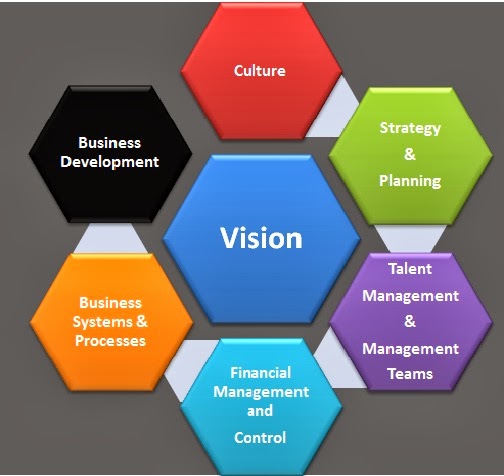
Secondly, it requires a very broad range of business knowledge and expertise. Its something that few business owners are aware of, especially in the early stages when often they are struggling to make the mind shift from being an exponent of what they do to being the MD of a business that provides those products or services  Even if they are aware of it few business owners have thought about managing the impact of growth or assessing the interconnections between functions which accentuate both good and bad decisions. I've put them into seven areas. They are:

Vision, Culture, Strategy and Planning, Talent Management, Financial Management & Control, Business Processes and Business Development. The first are about leadership and infrastructure. The other 5 look at key business activities but will be much more effective if the infrastructure is in place. 

The challenge for a business in maintaining high growth is to grow the organisation consistently over time to match sales. In supporting businesses to understand and undertake this challenge in a knowledgeable way we are much more like to provide sustainable high growth businesses. 

Exigent Consulting provides specialist services to the Small and Medium Business including Managing High GrowthBusiness Turnaround, and Mentoring. We help business owners improve the profit performance of their business. 


Thursday, 26 April 2012

Healthy Culture Delivers Better Business Performance

  If You Haven't been to my blog before you might want to subscribe to my feed


Business performance and culture have always been linked, although its tended to be anecdotal evidence rather than hard statistics. I myself as part of our High Growth Programme spend some time on the importance of understanding your culture and analysing if it is suitable and desirable for your business going forward. I wrote about these issues on using culture as a support to high growth and culture as a weapon for competitive advantage. Whilst there is little doubt the having the right culture is an important factor in improving your business performance it remains an area that most smaller business owners tend to avoid. It is fair to say that much of this is because business advice and support tends to look at the process driven solutions for business rather than addressing the more difficult area of people, their values and motivations. 


It has always been my contention that getting your organisational culture right will improve your competitive performance and support a company's high growth aspirations because they empower people to be courageous and offer sultions and challenge norms without fear of reprisals or blame. 


Up until now there has not been any hard numbers to support this view. However last June an article was published in McKinseys Quarterly which had actually put numbers to the importance of culture in business performance. As can be seen in the diagram above business performance addressing change plus a healthy culture outperformed poor cultures by as much as 2.2x. This is I expect the first of many such studies as the recognition thart culture plays an important part in supporting a companys success becomes a topic at the centre of a CEO's radar.

Exigent Consulting provides specialist services for High Growth Business Business Turnaround, and Mentoring to the Small and Medium Business. We help business owners improve the profit performance of their business. 


Wednesday, 4 April 2012

Culture - Finding Out What You have

  If You Haven't been to my blog before you might want to subscribe to my feed

Recently I wrote about the importance of culture in supporting high growth persistent businesses. I've had a couple of requests from business owners if there was somewhere they could get a sample list of questions which they could use as a starting point for a survey on culture. Not having found anything immediately available I put together a list of 20 sample questions that I thought might be useful.

The question on culture are as follows, fell free to use them as you wish. The most important factor to consider is that answers should be anonymous otherwise your employees will be too busy trying to second guess what they think the answer should be rather than what is the truth.


1. Is the pressure to perform unreasonable?

2. Are targets set by managers unreasonable?

3. Would you prefer to work for a fast moving innovative company or a slow moving cautious company?

4. Is it sometimes difficult to ask questions or raise concerns?

5. Are we a  quality company?

6. Is bad conduct rewarded, tolerated or punished?

7. Is there a close tie between performance and rewards?

8. Do employees consider that the company understands and sufficiently care about the needs of its customers?

9. Is the quality of products and/or services a high priority?

10. Are employees proud of our products and/or services?

11. Do we sell our products based on price or quality?

12. Would you get more criticism for violating an ethical principle than not meeting a deadline or target?

13. It is safe to voice your opinion…true or false?

14. The company turns a blind eye to unethical behaviour if it means getting a sale...true or false?

15. There is one code of ethics for everyone....true or false?

16. We are encouraged to admit mistakes and learn from them...true or false?

17. Are you asked to perform tasks that your mangers would not be prepared to do?

18. Do you ever feel let down by your colleagues?

19. Are your mangers supportive?

20. Which words do you think best describes the company culture as Open, Oppressive, a Meritocracy, Political, Supportive or other?... please specify.

Once you have this information you can follow the steps from my article Culture - getting the one you want on how you can implement changes.

Exigent Consulting provides specialist services for High Growth Business Business Turnaround, and Mentoring to the Small and Medium Business. We help business owners improve the profit performance of their business. 


Friday, 16 March 2012

Culture - Getting the One You Want

  If You Haven't been to my blog before you might want to subscribe to my feed

This short article will give you practical steps to identify the culture you have now and the culture you would like to have to support you as a high growth business.  We have talked earlier about the importance of a strong company culture in a high growth business and how it should be a critical part of your business strategy as it can provide real competitive advantage.


Whilst many owners in high growth businesses understand the need for a strong company culture, their business have developed without any clear focus on this aspect. There is a need therefore for a simple process to identify he differences between the culture you have now to the culture you want, and identify how to go from one to the other.

It is worth repeating that if you run a business you will have a culture. You get this by default, your company culture will be created by your values and the values of your employees. Those with the strongest personality or who are the most vocal will tend to create a dominant culture. To enable you as an owner of high growth businesses to grow faster for longer getting the right culture is a must.

Step 1 Find out what you have now. 

The simplest way to do this is for you to identify the 3 to five words which you think together describe your company culture, so for example; honesty, reliability, easy to do business with, supportive, positive.

Step 2 Find out if your staff agree

Produce a list of maybe 15 to 20 words and include you 5 initial words in that list. Ask your staff to highlight 5 words which they think best describes the company culture. By the way make sure the response to this survey is anonymous otherwise you'll have staff telling what they think you want to hear, rather than what they really think.

Step 3 Analyse the results

You are most likely to get one of three results

(a) there is a lot of similarity between your view of your company culture and that of your staff
(b) there doesn't seem to be any prevailing view of your culture amongst your employees. This suggests what ever your culture is, it is weak.
(c) your employees have a completely different view of your company's culture from you.

Step 4 Identify the culture you want

Using the same technique as in step 1. Find a few keywords that will identify your new culture.

Step 5 Create culture champions

As a busy owner of a high growth business you don't have either the time or the capability on your own to change your staffs attitudes. You will need the help of other key members of the team to become "cultural champions" to keep reinforcing the new cultural message. 

Step 6 Implement your new culture

Encourage and support your cultural champions to work with your staff to implement those changes into you company culture. Where are you most likely to be successful? Recruitment is great starting point as you can filter out those potential staff who like and agree with your culture. As I have stated before this is especially important in a high growth business as new recruits become productive faster.

This last step may take some time depending on how different it its from your current culture. Don't let that put you off as evidence has shown that a high growth business with a strong supportive culture will grow faster and for longer than a business which has not.

Exigent Consulting provides specialist services for High Growth Business Business Turnaround, and Mentoring to the Small and Medium Business. We help business owners improve the profit performance of their business. 


Friday, 9 March 2012

Managing High Growth: Using Your Culture for Competitive Advantage

  If You Haven't been to my blog before you might want to subscribe to my feed
In my earlier piece about the importance of culture in high growth businesses I talked about how culture is considered a soft skill and that most business people tend to ignore it, mostly because there is no imm
Aleutian Cultures
Aleutian Cultures (Photo credit: Travis S.)
ediate quantifiable benefit and of course because it involves dealing with people. That's for HR people isn't it?

What I wanted to share in this post was the idea that culture can be a potent weapon by giving you an important competitive advantage. If implemented and understood it can help significantly in promoting a company's growth. Your culture establishes how your company and its staff interact with one another and with the outside world (your customers and prospects). It reflects your core values and your ethics.

So how is this a competitive weapon? Well lets look at two areas where High Growth Businesses experience problems. Finding and keeping the right staff and dealing with new problems. 

All high growth businesses face many challenges which are outside the experience of the owners or the senior staff. There is naturally a high degree of risk involved in making decisions in this environment. However as a business owner you don't want to be the only person who makes these decisions and by getting your staff to face these issues it in turn develops their skills. In order for your staff to be confident about making these decisions you must have the right culture in place. That is firstly to allow them to make decisions and not be afraid of making mistakes; and secondly a culture which support risk management so decision making can be shared across the management team and moves away from blaming individuals. Having the kind of culture which supports this kind of decision making will give you a real competitive advantage.

The other area is the strength of your culture. One of the major growth inhibitors is not getting enough of the right kind of people together with the time taken to integrate them  into your business to become fully productive. Having a strong culture creates what I have termed a cultural wall it works like this.

A company'as cultural wall uses a strong culture to ensure that only those potential employees who align with your culture will stay with the company. Those who are not fully committed or are trying to change it will bounce off the wall. That is either deliberately not join or leave soon after joining. Those who align with your culture will cross the wall and feel protected. This affinity leads to significantly lower attrition and a quicker absorption of new staff bringing them up to full productivity quicker, not to mention the increased likelihood of staff putting in more effort and extra hours into something to which they feel fully committed. 

By contrast those organisations with a weak or poorly developed culture suffer from inherently higher attrition as left unchecked people develop pockets of competing cultures, which results in a generally high level of attrition, and an increased chance that new employees will take longer to get up to speed. 

It should be obvious from the above how important Culture is to a business, the quicker companies get to grips with this the better their chance of longer term high growth.

Exigent Consulting provides specialist services for High Growth Business Business Turnaround, and Mentoring to the Small and Medium Business. We help business owners improve the profit performance of their business. 


Wednesday, 26 October 2011

Managing a High Growth Business: Its the Culture, Stupid!

  If You Haven't been to my blog before you might want to subscribe to my feed
Culture is one of the most under rated aspects influencing a business. Get it right and you can support and promote cooperation to support and reinforce success. Get it wrong and you can say goodbye to a successful business and say hello to a world of hurt.
British poet and critic Matthew Arnold viewed ...Image via Wikipedia
BRITISH POET AND CRITIC MATTHEW ARNOLD
VIEWED "CULTURE" AS THE CULTIVATION
 OF THE HUMANIST IDEAL.

Every business has a culture whether you know it or not, whether you've consciously tried to set one or not.  Culture is set the day you start a business as it is a reflection of you, the owner, your values and personality. So if you like playing politics, politics will become an integral part of the business. Your values on customer service, sales, staff management in fact everything you do in business both internally and externally is influenced, if not dictated, by your culture.

Given its importance why is Culture not higher up on the list of things to explore when building a business.  In fact it’s often completely overlooked. The reason for this I would suggest is that the critical impact that Culture has on a business is not well understood. It is often completely overlooked by advisers and start ups alike, under the misguided impression that culture is something for a big business to consider. This totally ignores the fact that having the wrong culture is likely to prevent you from getting to a big company in the first place.    It is also because Culture is one of those soft touchy feely issues that tend to be avoided by by business people and is shunned by an ever more materialistic society. This is not intended to be a commentary on the importance of culture in our society but rather impact ignorance as an owner of what your business culture is and what it should be.

Taking this analysis further; incompatible cultures, or rather a lack of interest by the sellers of business and ignorance of the importance by buyers is the number 1 reason why so many acquisitions fail or at least fail to deliver a significant portion of the expected benefits. More worryingly ignorance of the importance of culture is the most common reason why the cost of integration is substantially more than projected.

How do you identify your culture?

This is a two step process. Firstly identify what you would like your culture to be then secondly ask your staff what they think it is. In order to make it easier for your staff to explain what they think is the company culture, distil the description of your culture into a few words. So for example; customer service, quality and price. Also recognise that the order of the words indicates their importance. For example a business with the keyword priority customer service, quality and price will have a significantly different culture to a business whose keyword priority is price, quality and customer service. Try it, you’ll find the answer illuminating.

If the culture is not what we want, how do we change it?

Changes in culture are notoriously difficult to implement because we are trying to change people’s attitudes. Change starts with you, as in all probability, you created the original by your actions or the appearance of your actions.

Step 1 clearly define what you want your culture to be in as much detail as possible, explain your rationale, then go on to describe how you will expect your management and staff to act. Then you follow a long process of reinforcing the culture across the business, but how you do this is the subject of a future article.
Enhanced by Zemanta
Exigent Consulting provides specialist services for High Growth Business Business Turnaround, and Mentoring to the Small and Medium Business. We help Business Owners improve the profit performance of their business.