Featured post

What Do High Growth Businesses Do Differently?

Over the past 5 years the importance of the “High Growth Business” and how this relatively small group of businesses disproportionally impa...

Showing posts with label Organization. Show all posts

Friday, 8 November 2013

The High Growth Challenge

  If you haven't been to my blog before you might want to subscribe to my feed

Growing a business is a challenge in its own right, growing a business in an environment of  high growth is doubly difficult. To get an idea of just how difficult that is you only have to look at how few businesses manage to sustain high growth (20%pa) over say 4 years; and what a tiny percentage of those will achieve this state for a decade. So be under no illusion  sustaining high growth is a major challenge.

So what makes it so difficult? It is my contention that too many businesses focus on the wrong issue. In any business there are two basic components that need to grow together sales and the organisation. Sales is the easy bit. OK so thats a bit of an oversimplification. Growing sales is tough, how tough, depends to a significant degree on market growth. It is self evident that its harder to achieve high growth in a slow growing or even stagnant market compared to a market which is also in high growth. Some might even say that growing at 35% when your market is growing at 50% is actually under-performing. However too many so called growth experts focus on sales and marketing because thats the key driver. Absolutely true. What sustains high growth, however, is matching organisational growth to support sales growth and thats a whole different order of difficult.

Why is it so difficult? Firstly, because it involves managing multiple disciplines successfully not just one. Further these different functions have to, as far as possible, be kept in balance along the way. In addition the matching of organisation to sales has to be close enough to allow the business to make a profit sufficient to allow it to reinvest in maintaining growth. This is because for the most part businesses have to rely on their own cash generation to fund growth. There businesses that generate extra ordinary growth but this usually only possible because they have access to extra ordinary amounts of cash. Those cases aside it's up to the business owner to fund his own growth.

English: Hammer thrower Mike Mai practices at ...
English: Hammer thrower Mike Mai practices at Fort Lewis, July 1. (Photo credit: Wikipedia)
To illustrate this in a different way, let's use the analogy of a hammer thrower. At its basics you pick up the hammer rotate across the circle and hurl it into the distance. In reality it is a very technically demanding sport. The key to success is to remain in control even though your rotate faster and faster across the circle before launching the hammer into the distance. In order to be successful the hammer thrower needs to stay ahead of the hammer. This means that the hammer stays slightly behind the throwers rotation so that they retain control. If however the hammer gets ahead of the thrower then control switches immediately from the thrower to the hammer as they are in effect being pulled around by the hammer. The result is that the subsequent throw is out of control and either it crashes into the side netting or if by chance it does make the opening it has no great distance or direction. The problem for the hammer thrower is that if the hammer gets ahead of him it is impossible to slow the ball down a little bit to get back in control. Slowing down inevitably results in sufficient loss of momentum for the hammer to just falls to the ground. If we read sales growth for the hammer and organisational growth for the thrower we can see that if organisational growth falls behind sales growth the only way for the position to correct itself is for sales growth to slow. The problem is, that like the hammer falling to the floor, sales growth tends to stall completely.
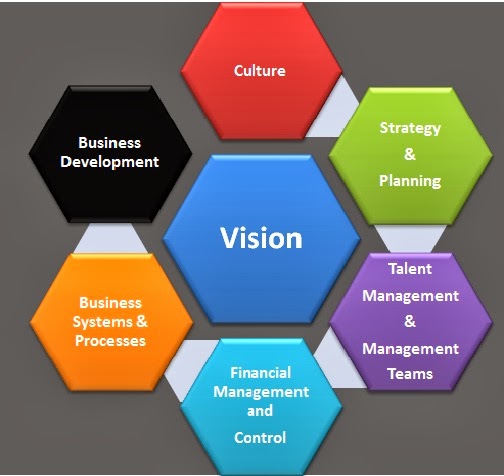
7 principles of Managing High GrowthThis common occurrence is evidenced by what I call "shooting star" businesses that shine brightly, for a brief time  then disappear. These are businesses that grow very rapidly for a year or so but then the wheels come off management spends the next year to 18 months clearing up the mess. Significantly this experience is so painful that the business often makes a conscious decision to avoid high growth in the future.

Secondly, it requires a very broad range of business knowledge and expertise. Its something that few business owners are aware of, especially in the early stages when often they are struggling to make the mind shift from being an exponent of what they do to being the MD of a business that provides those products or services  Even if they are aware of it few business owners have thought about managing the impact of growth or assessing the interconnections between functions which accentuate both good and bad decisions. I've put them into seven areas. They are:

Vision, Culture, Strategy and Planning, Talent Management, Financial Management & Control, Business Processes and Business Development. The first are about leadership and infrastructure. The other 5 look at key business activities but will be much more effective if the infrastructure is in place. 

The challenge for a business in maintaining high growth is to grow the organisation consistently over time to match sales. In supporting businesses to understand and undertake this challenge in a knowledgeable way we are much more like to provide sustainable high growth businesses. 

Exigent Consulting provides specialist services to the Small and Medium Business including Managing High GrowthBusiness Turnaround, and Mentoring. We help business owners improve the profit performance of their business. 


Wednesday, 26 October 2011

Managing a High Growth Business: Its the Culture, Stupid!

  If You Haven't been to my blog before you might want to subscribe to my feed
Culture is one of the most under rated aspects influencing a business. Get it right and you can support and promote cooperation to support and reinforce success. Get it wrong and you can say goodbye to a successful business and say hello to a world of hurt.
British poet and critic Matthew Arnold viewed ...Image via Wikipedia
BRITISH POET AND CRITIC MATTHEW ARNOLD
VIEWED "CULTURE" AS THE CULTIVATION
 OF THE HUMANIST IDEAL.

Every business has a culture whether you know it or not, whether you've consciously tried to set one or not.  Culture is set the day you start a business as it is a reflection of you, the owner, your values and personality. So if you like playing politics, politics will become an integral part of the business. Your values on customer service, sales, staff management in fact everything you do in business both internally and externally is influenced, if not dictated, by your culture.

Given its importance why is Culture not higher up on the list of things to explore when building a business.  In fact it’s often completely overlooked. The reason for this I would suggest is that the critical impact that Culture has on a business is not well understood. It is often completely overlooked by advisers and start ups alike, under the misguided impression that culture is something for a big business to consider. This totally ignores the fact that having the wrong culture is likely to prevent you from getting to a big company in the first place.    It is also because Culture is one of those soft touchy feely issues that tend to be avoided by by business people and is shunned by an ever more materialistic society. This is not intended to be a commentary on the importance of culture in our society but rather impact ignorance as an owner of what your business culture is and what it should be.

Taking this analysis further; incompatible cultures, or rather a lack of interest by the sellers of business and ignorance of the importance by buyers is the number 1 reason why so many acquisitions fail or at least fail to deliver a significant portion of the expected benefits. More worryingly ignorance of the importance of culture is the most common reason why the cost of integration is substantially more than projected.

How do you identify your culture?

This is a two step process. Firstly identify what you would like your culture to be then secondly ask your staff what they think it is. In order to make it easier for your staff to explain what they think is the company culture, distil the description of your culture into a few words. So for example; customer service, quality and price. Also recognise that the order of the words indicates their importance. For example a business with the keyword priority customer service, quality and price will have a significantly different culture to a business whose keyword priority is price, quality and customer service. Try it, you’ll find the answer illuminating.

If the culture is not what we want, how do we change it?

Changes in culture are notoriously difficult to implement because we are trying to change people’s attitudes. Change starts with you, as in all probability, you created the original by your actions or the appearance of your actions.

Step 1 clearly define what you want your culture to be in as much detail as possible, explain your rationale, then go on to describe how you will expect your management and staff to act. Then you follow a long process of reinforcing the culture across the business, but how you do this is the subject of a future article.
Enhanced by Zemanta
Exigent Consulting provides specialist services for High Growth Business Business Turnaround, and Mentoring to the Small and Medium Business. We help Business Owners improve the profit performance of their business.  


Friday, 24 June 2011

Managing A High Growth Business : Matching Your Organisation to Your Sales

  If You Haven't been to my blog before you might want to subscribe to my feed

 Growth Businesses Organisational Stress Points
This is the first in a series of posts concerning the successful management of high growth businesses. One of the most common problems high growth businesses face is how to match organisational growth with sales. 

The Problem 

Simply put sales can grow discretely and tends to be quite smooth as shown as the red curve. Organisations growth, by contrast, tends to be much more lumpy. This is because a certain staffing complement has a finite growth capacity and beyond that point just adding people doesn't help. In fact at some point adding people reduces performance. What is required is an organisational restructure which will create a step change in a companies ability to support its growth. However this is not easy to accomplish because most SME's address this problem too late. This often results in business growth reverting to the typical "lumpy" organisational restructure rather than a smooth increase. The reason for this is that sales now have to wait for the organisation to catch up so you tend to end up with a year of rapid growth followed by a year or even more of no or even negative growth.

Typical Situations

Smaller Businesses tend to rely too heavily on a few key people, this results in a stagnation of performance of the remaining staff who have little or no chance to develop their skills. So when the time comes to reorganise the business owners or management are reluctant to make the step change necessary to reorganise the business because they cant see who, apart from the usual suspects, who will be able to take on additional responsibility.  What this results in is either a re-oganisation which is often half hearted or too late.  To provide a sporting analogy, hammer throwers are always told that they must remain ahead of the hammer. So as they speed up their revolutions in the circle they can properly time an effective throw. Small businesses rather like a novice hammer thrower end up behind the hammer (read sales growth)  losing control and finding out the hammer is in the wrong place.

The Solution

"Stay ahead of the Hammer!" 

Some key actions:

Always! Always Always! Implement a reorganisation ahead of its need. This gives you time to fine tune it is also the only way you can main that rapid growth.

Establish a model for organisational growth. That is how will your business deal will sustained and rapid growth. Your plan must also be able to estimate at what point (size of revenues) will you be needing to consider the next reorganisation.

Reorganisations must have longevity. Typically a major reorganisation should last about 24 months, with interim adjustments taking place yearly.

Recognise that reorganisations get bigger as you get bigger, so have a post reorganisation quality control process.

Let me know what you think


Exigent Consulting provides specialist services for High Growth Business Business Turnaround, and Mentoring to the Small and Medium Business. We help Business Owners improve the profit performance of their business.