Featured post

What Do High Growth Businesses Do Differently?

Over the past 5 years the importance of the “High Growth Business” and how this relatively small group of businesses disproportionally impa...

Showing posts with label Managing High Growth. Show all posts

Tuesday, 1 April 2014

What Do High Growth Businesses Do Differently?

Percent Symbols - Best Percentage Growth or In...
That’s a question that most of us find intriguing because we all want to know the secret of success. Many business owners I know, whom others might consider successful, are themselves a little nervous as they don’t really understand why they got to where they are now. Their problem, obviously, is that if they don't understand why they got there in the first place; they won’t know what to do if things go wrong.

You might have noticed that more recently I have been focusing on ambitious business owners that are seeking to rapidly grow their business. These High Growth businesses provide us with some valuable insights about how to be successful. A recent survey of High Growth businesses in the USA by Hinge Marketing concluded that there were 4 things that high growth businesses do differently from others, which contributed to their growth.

1. They focus on delivering client’s desired outcomes. They were not touting the firm’s qualifications or their products or service strengths but rather what the results were of providing their product or services and what it meant to the client. This idea of focusing on outcomes makes them much more likely to deliver as they have their eyes on the prize.

2. They are truly customer focused; their job is to make the client’s life easier. You won’t hear complaints about customer attitude or how clients are making their life difficult. They see a problem with a customer as an opportunity for them to improve. Some businesses are actually disappointed if they don’t get negative feedback from their clients as it doesn't give them the opportunity to further improve their business.

3. They are flexible. They recognise how much, both prospects and clients, value flexibility and very many high growth businesses feature flexibility in their marketing and sales material.

4. They focus on their reputation. They work very hard at promoting and protecting their reputation and their brand.

There is a 5th thing that High Growth businesses do, or rather and interestingly what they don’t do and that is spend excessive amounts on marketing. Surprisingly, High Growth businesses spend slightly less than the average business on marketing. You'd intuitively expect that High Growth businesses (in this case growing @ 20% plus pa over 2 years) would be spending disproportionately more. However the survey indicated that these " High Growth " businesses spent only 4.9% of their revenues on marketing as opposed to 5.1% for the average business.

This leads to the obvious question; how do they do that? Whilst I have no empirical evidence I can anecdotally, at least, support this finding. If I look at those High Growth businesses I've worked with virtually all of them spent much less on marketing than you’d expect. Having looked into this further it seems to me that many High Growth businesses have accidentally locked on to something which fits the market demands better than the competition and the clarity of their proposition has got prospects pounding at their door. 

I can think of two obvious examples; one a construction business that is currently experiencing an 80%pa growth over this year and forecasting similar next with no marketing spend at all. In fact they are receiving so many enquiries that they are hard pressed to respond at all.  Looking at it for the first time you might even think that their sales process was broken. Yet despite all of that their growth is and continues to be phenomenal. Why, "word of mouth". They will move heaven and earth to get things right first time. This attitude marks them out from their competition and keeps both existing and new customers approaching them for proposals.

The second is a services business which has landed several strategic contracts with some very high profile companies in the UK, with no formal sales function and more startlingly having no one with any formal sales training. Its success once again appears purely based on what it can deliver and “word of mouth” from a couple of existing clients.

What I find interesting is that the results of this report suggest that a business’s success has much more to do with how well they had thought through why and how they deliver their product or service and their value proposition and much less to do with the size of their wallet.

For a full download of the Hinge Marketing report click here.

Exigent Consulting provides specialist services to the Small and Medium Business including Managing High GrowthBusiness Turnaround, and Mentoring. We help business owners improve the profit performance of their business. 


Friday, 8 November 2013

The High Growth Challenge

  If you haven't been to my blog before you might want to subscribe to my feed

Growing a business is a challenge in its own right, growing a business in an environment of  high growth is doubly difficult. To get an idea of just how difficult that is you only have to look at how few businesses manage to sustain high growth (20%pa) over say 4 years; and what a tiny percentage of those will achieve this state for a decade. So be under no illusion  sustaining high growth is a major challenge.

So what makes it so difficult? It is my contention that too many businesses focus on the wrong issue. In any business there are two basic components that need to grow together sales and the organisation. Sales is the easy bit. OK so thats a bit of an oversimplification. Growing sales is tough, how tough, depends to a significant degree on market growth. It is self evident that its harder to achieve high growth in a slow growing or even stagnant market compared to a market which is also in high growth. Some might even say that growing at 35% when your market is growing at 50% is actually under-performing. However too many so called growth experts focus on sales and marketing because thats the key driver. Absolutely true. What sustains high growth, however, is matching organisational growth to support sales growth and thats a whole different order of difficult.

Why is it so difficult? Firstly, because it involves managing multiple disciplines successfully not just one. Further these different functions have to, as far as possible, be kept in balance along the way. In addition the matching of organisation to sales has to be close enough to allow the business to make a profit sufficient to allow it to reinvest in maintaining growth. This is because for the most part businesses have to rely on their own cash generation to fund growth. There businesses that generate extra ordinary growth but this usually only possible because they have access to extra ordinary amounts of cash. Those cases aside it's up to the business owner to fund his own growth.

English: Hammer thrower Mike Mai practices at ...
English: Hammer thrower Mike Mai practices at Fort Lewis, July 1. (Photo credit: Wikipedia)
To illustrate this in a different way, let's use the analogy of a hammer thrower. At its basics you pick up the hammer rotate across the circle and hurl it into the distance. In reality it is a very technically demanding sport. The key to success is to remain in control even though your rotate faster and faster across the circle before launching the hammer into the distance. In order to be successful the hammer thrower needs to stay ahead of the hammer. This means that the hammer stays slightly behind the throwers rotation so that they retain control. If however the hammer gets ahead of the thrower then control switches immediately from the thrower to the hammer as they are in effect being pulled around by the hammer. The result is that the subsequent throw is out of control and either it crashes into the side netting or if by chance it does make the opening it has no great distance or direction. The problem for the hammer thrower is that if the hammer gets ahead of him it is impossible to slow the ball down a little bit to get back in control. Slowing down inevitably results in sufficient loss of momentum for the hammer to just falls to the ground. If we read sales growth for the hammer and organisational growth for the thrower we can see that if organisational growth falls behind sales growth the only way for the position to correct itself is for sales growth to slow. The problem is, that like the hammer falling to the floor, sales growth tends to stall completely.

7 principles of Managing High GrowthThis common occurrence is evidenced by what I call "shooting star" businesses that shine brightly, for a brief time  then disappear. These are businesses that grow very rapidly for a year or so but then the wheels come off management spends the next year to 18 months clearing up the mess. Significantly this experience is so painful that the business often makes a conscious decision to avoid high growth in the future.

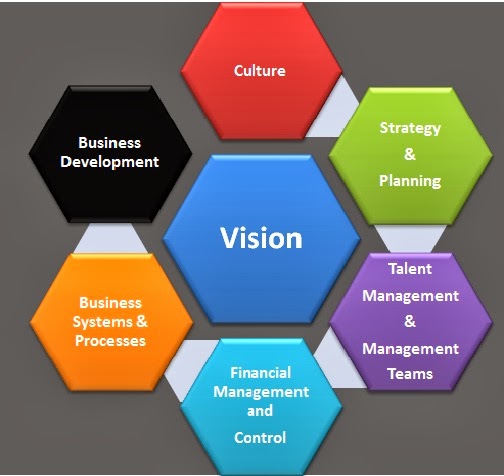
Secondly, it requires a very broad range of business knowledge and expertise. Its something that few business owners are aware of, especially in the early stages when often they are struggling to make the mind shift from being an exponent of what they do to being the MD of a business that provides those products or services  Even if they are aware of it few business owners have thought about managing the impact of growth or assessing the interconnections between functions which accentuate both good and bad decisions. I've put them into seven areas. They are:

Vision, Culture, Strategy and Planning, Talent Management, Financial Management & Control, Business Processes and Business Development. The first are about leadership and infrastructure. The other 5 look at key business activities but will be much more effective if the infrastructure is in place. 

The challenge for a business in maintaining high growth is to grow the organisation consistently over time to match sales. In supporting businesses to understand and undertake this challenge in a knowledgeable way we are much more like to provide sustainable high growth businesses. 

Exigent Consulting provides specialist services to the Small and Medium Business including Managing High GrowthBusiness Turnaround, and Mentoring. We help business owners improve the profit performance of their business. 


Monday, 28 May 2012

How Not to Lose Money on Fixed Price Work

  If You Haven't been to my blog before you might want to subscribe to my feed
Fixed price work seem to be a problem for many of you. In recent discussions with a variety of professional services businesses, ranging from accountants, through consultants, to IT businesses it is clear that for you fixed price work is rarely profitable, and often a source of problems and most times a situation where you lose money. Yet despite this you seem to ignore your experiences and through gritted teeth continue to offer fixed priced work to clients.

Fixed Price tariffs: are they still a good deal?
Fixed Price tariffs: are they still a good deal? (Photo credit: uSwitch)
Lets be honest fixed price work is very appealing to your clients and prospects; it gives them confidence because they get a firm price for delivery of a project (web site) (IT system) or a combination of services ( accountants, consultants). So why is it so easy to lose money on this type of work? Simply as a result of three problems, first most businesses and especially professional services businesses aren't sufficiently detailed in their analysis of what work needs to be done, secondly as a result of poor communication and management of client expectations and last a lack of commercial awareness. Following a few simple steps you can turn these troublesome children which lose money into profitable business with happy clients.

The first problem is is not having a handle on the amount of effort involved in providing the service you are offering. This is often the root cause of you losing money fixed price work. Why? because you tend to be too optimistic about how long it will actually take to complete the work. Also as there is no clarity on what effort it will take because there is no detailed scope work. Not doing this basic estimating first creates a problem for you because you cant clearly define the limits of what you will do for the price and as a result your customer can drag you into doing much more work than you expected but all within the original quote for the fixed price work.

The second problem comes from that dangerous word "assume". That is you assume that your customer understands the basis on which you are quoting and how much effort you are going to put into your fixed price work. Your customer by contrast assumes that you can read his mind and understands his assumptions, which of course only come to light when you think you've finished the work and he thinks there is a lot more for you to do. So stop putting yourself in a position to lose money by writing down exactly what you will do and to what level of detail. This is a particular problem if you are a professional services business because it is very rare for you to consider the depth to which you will undertake a service rather just saying it will be addressed. So don't assume anything, let you client or prospect know IN WRITING clearly and up front what you will be doing and in how much detail . Then get them to sign that off. Once you've done this you have an agreed baseline.

The third problem is lack of commercial awareness. I'm surprised how many professional services companies for example will offer fixed price work more cheaply than you would charge on a time sheet basis. This makes no sense; ask yourself this. Who is taking the risk, well in fixed price work it is you! so you should be charging a premium not a discount. For many of the larger professional services businesses this would be anything from 15 to 33% depending on the level of risk. 


The other issue is stage payments. So many professional services businesses offer something like 50% up front and 50% on completion. Its great for you to get 50% up front but stupid to leave 50% of the fees on the table when you will have completed all the work. It is particularly bad because it puts you in a week negotiating position as when you get to the end you'll really want that 50% so you'll end up giving in to every little demand and variance your client wants to include and believe me with a commercially astute client there will be plenty of them. I suggest, actually i'd like to insist, instead that you ask for stage payments that give you 80-90% of your fixed fees before work is completed. For example 30% up front 30% when design or other milestone is agreed 30% on delivery of the work and 10% after acceptance or when the report etc is accepted.

Its easy not to lose money on fixed price work, you just need to be a little more organised in your approach to your prospects.

Exigent Consulting provides specialist services for High Growth Business Business Turnaround, and Mentoring to the Small and Medium Business. We help business owners improve the profit performance of their business. 


Friday, 9 March 2012

Managing High Growth: Using Your Culture for Competitive Advantage

  If You Haven't been to my blog before you might want to subscribe to my feed
In my earlier piece about the importance of culture in high growth businesses I talked about how culture is considered a soft skill and that most business people tend to ignore it, mostly because there is no imm
Aleutian Cultures
Aleutian Cultures (Photo credit: Travis S.)
ediate quantifiable benefit and of course because it involves dealing with people. That's for HR people isn't it?

What I wanted to share in this post was the idea that culture can be a potent weapon by giving you an important competitive advantage. If implemented and understood it can help significantly in promoting a company's growth. Your culture establishes how your company and its staff interact with one another and with the outside world (your customers and prospects). It reflects your core values and your ethics.

So how is this a competitive weapon? Well lets look at two areas where High Growth Businesses experience problems. Finding and keeping the right staff and dealing with new problems. 

All high growth businesses face many challenges which are outside the experience of the owners or the senior staff. There is naturally a high degree of risk involved in making decisions in this environment. However as a business owner you don't want to be the only person who makes these decisions and by getting your staff to face these issues it in turn develops their skills. In order for your staff to be confident about making these decisions you must have the right culture in place. That is firstly to allow them to make decisions and not be afraid of making mistakes; and secondly a culture which support risk management so decision making can be shared across the management team and moves away from blaming individuals. Having the kind of culture which supports this kind of decision making will give you a real competitive advantage.

The other area is the strength of your culture. One of the major growth inhibitors is not getting enough of the right kind of people together with the time taken to integrate them  into your business to become fully productive. Having a strong culture creates what I have termed a cultural wall it works like this.

A company'as cultural wall uses a strong culture to ensure that only those potential employees who align with your culture will stay with the company. Those who are not fully committed or are trying to change it will bounce off the wall. That is either deliberately not join or leave soon after joining. Those who align with your culture will cross the wall and feel protected. This affinity leads to significantly lower attrition and a quicker absorption of new staff bringing them up to full productivity quicker, not to mention the increased likelihood of staff putting in more effort and extra hours into something to which they feel fully committed. 

By contrast those organisations with a weak or poorly developed culture suffer from inherently higher attrition as left unchecked people develop pockets of competing cultures, which results in a generally high level of attrition, and an increased chance that new employees will take longer to get up to speed. 

It should be obvious from the above how important Culture is to a business, the quicker companies get to grips with this the better their chance of longer term high growth.

Exigent Consulting provides specialist services for High Growth Business Business Turnaround, and Mentoring to the Small and Medium Business. We help business owners improve the profit performance of their business. 


Tuesday, 24 January 2012

The Problems of Managing High Growth

  If You Haven't been to my blog before you might want to subscribe to my feed

I am departing from my usual form of posting to include a link to an excerpt from a recent Webinar on managing high growth businesses. This short section, about 5 minutes, explores the problems of managing high growth and the consequences if not managed properly. 

As this is not my usual form I am especially interested in our feedback as it will help me decide i this approach is worth adopting for future posts.


Exigent Consulting provides specialist services for High Growth Business Business Turnaround, and Mentoring to the Small and Medium Business. We help business owners improve the profit performance of their business. 


Tuesday, 17 January 2012

The 6 Signs of Dysfunctional Company Boards

  If You Haven't been to my blog before you might want to subscribe to my feed
I have written in the past few weeks about the problem with board meetings and the problem with sales meetings. It was suggested to me that it might be helpful if I explained what particular issues with a dysfunctional company board and how a well run company board would operate. In this article I intend to concentrate on dysfunctional boards or boards in crisis. 

English: "Wilshire Room," company in...
Image via Wikipedia
So lets remind ourselves what issues should be addressed at board meetings? They’re the meeting that set the direction for the company, confirm policy, and directs the business response to unforeseen events either external like for example a significant change in market conditions or the arrival of a new or stronger competitor. The unforeseen events maybe internal like the loss of key staff or a major issue with sales or production. To get the best out of these meetings they should be held regularly and it should involve a review of the company’s performance.  

So, if that's what a Board meeting should cover what do we typically see in a dysfunctional or crisis board.

Number 1 is not understanding the importance of a board meeting. As individuals and owners we tend work and think at an operational or detail level and it takes some effort and often some training to start to look at strategic and policy issues at a high level. Because operational issues tend to be more immediate and therefore urgent they get in the way of longer term but no less important considerations. Boards meetings are vital to the long term health of a business and are a necessary condition if you want a business to be successful over the long run. I have seen many situations where Board Meetings have gradually been dropped because well meaning owners and managers confuse them with operations or management meeting. Often its only when a crisis hits the business that the management team understand its importance and by then it can be too late.

Number 2 is where day-to-day operations dominate meetings. This is the most common situation and is a result of the first symptom.   Typically the meeting will have no agenda and the participants will have made little or no preparation, consequently what gets discussed is what is on peoples minds at the time (management issues).

Number 3 is not having external advisers. In order to understand and address strategic issues, and probably any issue, it is beneficial to get external advice from people who are not intimately involved in the business. These people can be Non Executive Directors or external advisers.  This separation gives them the ability to make key insights  about the business and its relative performance that would not be possible from internal managers and directors, who often "cant sees the woods for the trees".


Number 4 is hearsay management. This is a situation where the business owner/ CEO makes decisions based on their gut instinct or impulse and without proper evidence. In these situations boards are often seen as a hindrance because board meetings are a forum where   members can question and review key decisions. This type of situation is often coupled with number 5 where the CEO/MD has a low opinion of the management team and doesn't see great value in their input or they don't want to be challenged. I have found this later situation common in family run businesses where the control is kept within the family irrespective of capability and the unwanted scrutiny of a board meeting is something to avoid.


Number 6 the  festering issue/disruptive director. These two often go hand in hand and the disruptive director is often a result of a long running issue that has been ignored, where he or they consider that a poor or no decision has been taken on a subject of great importance to them and despite numerous attempts the problem is avoided leaving a disgruntled board member. The result is that they will go to great lengths to try to raise the issue whilst everyone else will do their best to avoid it, as a result issue and those connected issues are not properly discussed and frequently board meetings are delayed or cancelled as part of the avoidance process. This situation is especially common where you have strong characters who will be persistent in the cause to the point of absurdity and in the long run is very damaging to a team. Often a climate of distrust will develop and worsen team relations the longer the issue is not openly discussed and some form of conclusion reached.


Whilst there are many issues surrounding board meetings don't let this list put you off, many companies have a well functioning board. My next blog post will look at what a properly functioning board look like. I would also like to take the opportunity to give my thanks to Ivor Middleton who assisted in the preparation of this article.
Exigent Consulting provides specialist services for High Growth Business Business Turnaround, and Mentoring to the Small and Medium Business. We help Business Owners improve the profit performance of their business. 


Friday, 30 December 2011

The Problem with Sales Meetings......

  If You Haven't been to my blog before you might want to subscribe to my feed
Some while ago I wrote a short piece on the problem with board meetings, following work with recent clients it seems that there is also problems with sales meetings. Let me recount recent experiences to illustrate what I mean. The meeting starts well and their is an Agenda of sorts. What happens next is that a member of the team is asked to describe what they have done for the preceding month. There follows a long rambling commentary about how busy they have been and what opportunities their are and a volley of reasons why they haven't sold us much as they thought. This monologue took about 20 minutes.
Sales
Image by Nils Geylen via Flickr

The next member of the sales team them repeated the process with one objective in mind; to spend more time talking that the person before him. Repeat that four times and your have a very long sales meeting. In the worst case it was 6 hours, yes, 6 hours I kid you not. Worst still, at least from my point of view, was that very little valuable information was provided either to management or from management. It was also clear that the sales team saw the meeting as largely a waste of time, and at 6 hours who can blame them. Having said that the sales team were also part of the problem.

Sales people by definition quite hard to manage. This is because they are trained to handle objections (management questioning) and get around obstacles (management questions and reporting). Put another way without a strong focus its difficult to put sales people on the spot. Except of course when they've just made a big sale and then of course they will remind you at every turn. We shouldn't criticise but simply understand that this is the nature of sales people and we just have to learn to manage it. 

So the problem with sales meeting is that they are run by managers who are not trained as sales managers and who have to deal with trained sales people. In many cases it's just an unfair fight. The result is often that sales people don't treat the meeting with the respect it deserves and take advantage of their managers' lack of experience. This is not universal but in my experience it is a common situation.

So if you fall in this category as a manager/owner what can you do about it?

It all starts with asking the right questions. Sales meeting reporting need to be precise and unequivocal. By that I mean getting information from your sales people that is binary either a yes or no. So to keep control of a sales meeting its best to get your sales people to report on items such as business won in the month business lost in the month and business expected to close in the next month (or weekly depending on your sales cycle). 

Getting sales people to report on numbers makes it easier for you to understand what is really going on. It also leaves much less wriggle room about what has or hasn't been achieved. As a manager/owner you will have a target for monthly sales you need to know  are they being achieved and if so is thee significant over or under achievement. Depending on the answer, which by the way can be identified from the reports, you will know what kinds of questions to ask. It also means you can get through the meeting more rapidly because it becomes a Q&A session rather than a series on monologues. Further it will be easier to identify actions to take place before the next meeting thereby providing focus for future meetings and making it easier for you to stay in control.

You can get a sample of reporting formats I've been discussing by clicking here and downloading them.

Exigent Consulting provides specialist services for High Growth Business Business Turnaround, and Mentoring to the Small and Medium Business. We help Business Owners improve the profit performance of their business. 


Thursday, 15 December 2011

I’m Sorry; But I’m Too Rich to Come into Work Today.

  If You Haven't been to my blog before you might want to subscribe to my feed
ÄŒesky: Logo Facebooku English: Facebook logo E...
Image via Wikipedia
Success produces some unusual problems for a business. I was reminded of such when I read recent article in Business Insider that the proposed Facebook IPO will create over 1000 millionaires. This article goes on to give examples of some of the more exc
essive plans of these potential millionaires. The big question for Facebook, is how many of them will want to go back to their mundane jobs with such a big bank account balance.

There is no doubt that a fair percentage of them will at least for the short term continue with their day jobs, but as the realisation about what their wealth can do for them you can expect to see an increasing number having days off because they are just too rich. 

 The immediate problem for Facebook is that there are just so many of them. Can you imagine the problem facing Facebook if they all left at once, the loss of intellectual as well as cultural capital would be enormous. The difficulty for Facebook is that the normal rules of engagement don’t apply. Withholding pay, gets the so what response, as does any disciplinary procedure even being sacked would hold little fear. In a curious way Facebook are in a similar position to the banks and loan defaults; that is there comes a point when the large numbers of potential leavers (defaulters) becomes more of a problem in itself than putting sanctions against individuals. 

This by no means a unique problem although it is rare, Microsoft faced a similar situation when they went public for the first time in 1986. There were faced with a large number of employees becoming millionaires and recognised the risks to the organisation. There is no silver bullet solution for this type of scenario as it is rarely faced by any business. From the scraps of information I have been able to assemble it seems that Microsoft tried to focus on staff attitudes and attempts to promote the non financial reasons why people go to work as a way of minimising the potential impact of such significant staff attrition. 

They sought to identify reasons why very wealthy people would continue to come into work particularly if their jobs were relative low level. Senior Managers tend to be very driven and are often financially secure to a windfall would make a difference but not a significant one, for the most part. 

Image representing Mark Zuckerberg as depicted...
Image via CrunchBase
Technical staff were a different problem in that typically they are not motivated by money but the size of the windfall may disprove those assumptions. It seems that by offering ore technically challenging roles would go some way towards addressing the issue for this type of individual although equally you ant give them all more technically challenging rolls. 

The biggest batch of potential leavers is this in administrative jobs where a million dollars is a mind boggling sum of money. This group is the most difficult to deal with, so spending some 
time helping staff to prepare for the impending event will go some way towards exorcising the euphoria before the event. 

Microsoft managed reasonably well in coping with this problem but things have changed a little since the 1980’s and we are a much more materialistic in our outlook so the problem could be much worse for Mark Zuckerberg and friends.
Enhanced by Zemanta
Exigent Consulting provides specialist services for High Growth Business Business Turnaround, and Mentoring to the Small and Medium Business. We help Business Owners improve the profit performance of their business. 


Wednesday, 2 November 2011

Managing a High Growth Business: Getting your Vision Right

  If You Haven't been to my blog before you might want to subscribe to my feed
Very First Corn Flakes Package: http://www.kip...Image via    Wikipedia
Getting Your Vision Right 
I have worked with many high growth businesses and contrary to much of the published research it is clear that many owners of successful and high growth businesses do not have a clear vision of where they want to go or indeed and why they should need  to know.  Many of the business owners I have worked would describe themselves as accidental success stories. That is to say they can't explain why their business is consistently successful or what actions they put in place got them to where they are now. However what is common, they all recognise that this is not a satisfactory state of affairs. Formalising their thoughts into a vision is not just an academic exercise it is important to be able to articulate why you are business. 

A vision is not about targets or goals, it is about the reason you are in business for example Disney's vision is simply "To make people happy" Whilst Google's is "Make internet advertising better - less intrusive, more effective, and more useful" Kelloggs is  "To be the food company of choice"


You will all have some kind of vision in your head but to communicate it effectively to your staff and the outside world it needs to be put down on paper, in doing so it will help you clarify your vision. You will see from the examples I have shown that a company vision is not about targets or goals but why you do what you do and how you do it. It should not change and it should be just as valid whether you are a 5 person company or a 5000 person company. It should be timeless.

Getting your vision right is important for any business, but for a fast growing business it is essential. Having a vision will provide the common sense of direction that will focus peoples’ activities to the benefit of the business. This common purpose is vital for the maintaining of consistent fast growth.

Enhanced by Zemanta
Exigent Consulting provides specialist services for High Growth Business Business Turnaround, and Mentoring to the Small and Medium Business. We help Business Owners improve the profit performance of their business.