Featured post

What Do High Growth Businesses Do Differently?

Over the past 5 years the importance of the “High Growth Business” and how this relatively small group of businesses disproportionally impa...

Showing posts with label Talent Management. Show all posts

Thursday, 21 August 2014

The High Growth Challenge: Are You Winning on the Cultural Battleground?

Every business has a cultural battleground, for most the battle is little more than a skirmish. Even that, for many businesses, is something they struggle to win. For High Growth Businesses, winning on the cultural battleground is vital to their survival.

,Are you winning on the cultural battleground?
Are You Winning on the Cultural Battleground? (Photo credit: Wikipedia)
The first question you're probably asking is "where is the cultural battleground?". The answer is anywhere a new recruit comes into contact with your company. So in a small start up it is most likely to be the founders of the business. For a larger company it would most likely be their direct reports and for a business that is bigger still it will be the next level down. In general, it tends to be at the lowest levels of the company hierarchy where most interactions take place.  The cultural battleground is where new recruits come up against your company culture and will try to add their own influence the intensity  of the skirmish will be based on their own history and closeness to your business's culture. The further away the recruits culture from yours the more intense the skirmish.

For the business, winning on this battleground is vital, after all if it cannot integrate new staff into its existing culture readily, then individual skirmishes will persist and the existing staff will become battle weary and be even less effective in protecting your culture. More importantly for a High Growth Business, at some point this new recruit will become the company's face for other new recruits, who will want to push their own cultural norms. It is easy to see on this basis, how quickly a company's culture can be undermined and changed. Very often this can happen without the senior management being aware of the issue. It will only become apparent as they see employees become less committed not only to the company's values but also those processes put in place to make sure the culture remains embedded in the business.

So far we have only looked at this issue on an individual basis, now let's imagine the problem from the aspect of numbers. For example, over the next 18 months you expect to grow from 32 to 44 people. That assumes a growth rate of a little over 20% per annum. It involves taking on 12 people at a rate of 1 person every 6 weeks over 18 months. 

This strategy carries a risk to your current culture and customer experience; unless you can convert your new recruits to buy into your culture quickly enough, to prevent them from being polluted by other new recruits.  So in this case time is of the essence. Using our previous example, if it takes you 18 months to integrate a new recruit, you'll have a business with potentially up to 12 heretics in a group of 44 as none will have yet been integrated.  Under those circumstances it would be almost impossible to preserve your cultural values and you'd certainly lose the cultural battle. However, if you can integrate your new recruits in say 6 months then you'll only have 4 heretics in a group of 44, that's a much more manageable number.  Better still with the short integration time certainly 1 and possibly 2 of those five will be very close to integration giving you a great chance of winning on the cultural battleground.

As a High Growth Business it may be that you will be taking on new people about every month for the foreseeable future. Then this becomes a real concerted and incessant battle. No doubt your success has in part been achieved by the application of your cultural values and you’ll want to protect them to ensure your continued success, then winning on this battleground is a matter of survival. In which case to support your side you need to provide your “troops” with the best equipment. That will include:

1) A clear and strong recruitment process that seeks to take on only the best talent with the best cultural fit.
2) A comprehensive operations document which describes in detail “the way we do things here” and is what I call "The Big Colouring Book" of your business.
3) A well thought out and considered statement on your cultural values. Or what might be described as “why we do things the way we do things here”.
4) An induction and integration process which enables new recruits to understand “the why” thereby making it easier to accept “the how”.

The better prepared and supported your troops the more new recruits you can manage. If you get this right you can cope with almost any number of new recruits. I can give you two examples based on my own experience:

1) A company with a planned growth of 7 new starters per month for a year with a starting number of 120.
2) A subsidiary which, on the back of a big contact win, grew from 28 to 81 staff in a little over 10 months. 


Exigent Consulting provides specialist services for Managing High GrowthBusiness Turnaround, and Mentoring to the Small and Medium Business. We help business owners improve the profit performance of their business. 


Friday, 8 November 2013

The High Growth Challenge

  If you haven't been to my blog before you might want to subscribe to my feed

Growing a business is a challenge in its own right, growing a business in an environment of  high growth is doubly difficult. To get an idea of just how difficult that is you only have to look at how few businesses manage to sustain high growth (20%pa) over say 4 years; and what a tiny percentage of those will achieve this state for a decade. So be under no illusion  sustaining high growth is a major challenge.

So what makes it so difficult? It is my contention that too many businesses focus on the wrong issue. In any business there are two basic components that need to grow together sales and the organisation. Sales is the easy bit. OK so thats a bit of an oversimplification. Growing sales is tough, how tough, depends to a significant degree on market growth. It is self evident that its harder to achieve high growth in a slow growing or even stagnant market compared to a market which is also in high growth. Some might even say that growing at 35% when your market is growing at 50% is actually under-performing. However too many so called growth experts focus on sales and marketing because thats the key driver. Absolutely true. What sustains high growth, however, is matching organisational growth to support sales growth and thats a whole different order of difficult.

Why is it so difficult? Firstly, because it involves managing multiple disciplines successfully not just one. Further these different functions have to, as far as possible, be kept in balance along the way. In addition the matching of organisation to sales has to be close enough to allow the business to make a profit sufficient to allow it to reinvest in maintaining growth. This is because for the most part businesses have to rely on their own cash generation to fund growth. There businesses that generate extra ordinary growth but this usually only possible because they have access to extra ordinary amounts of cash. Those cases aside it's up to the business owner to fund his own growth.

English: Hammer thrower Mike Mai practices at ...
English: Hammer thrower Mike Mai practices at Fort Lewis, July 1. (Photo credit: Wikipedia)
To illustrate this in a different way, let's use the analogy of a hammer thrower. At its basics you pick up the hammer rotate across the circle and hurl it into the distance. In reality it is a very technically demanding sport. The key to success is to remain in control even though your rotate faster and faster across the circle before launching the hammer into the distance. In order to be successful the hammer thrower needs to stay ahead of the hammer. This means that the hammer stays slightly behind the throwers rotation so that they retain control. If however the hammer gets ahead of the thrower then control switches immediately from the thrower to the hammer as they are in effect being pulled around by the hammer. The result is that the subsequent throw is out of control and either it crashes into the side netting or if by chance it does make the opening it has no great distance or direction. The problem for the hammer thrower is that if the hammer gets ahead of him it is impossible to slow the ball down a little bit to get back in control. Slowing down inevitably results in sufficient loss of momentum for the hammer to just falls to the ground. If we read sales growth for the hammer and organisational growth for the thrower we can see that if organisational growth falls behind sales growth the only way for the position to correct itself is for sales growth to slow. The problem is, that like the hammer falling to the floor, sales growth tends to stall completely.

7 principles of Managing High GrowthThis common occurrence is evidenced by what I call "shooting star" businesses that shine brightly, for a brief time  then disappear. These are businesses that grow very rapidly for a year or so but then the wheels come off management spends the next year to 18 months clearing up the mess. Significantly this experience is so painful that the business often makes a conscious decision to avoid high growth in the future.

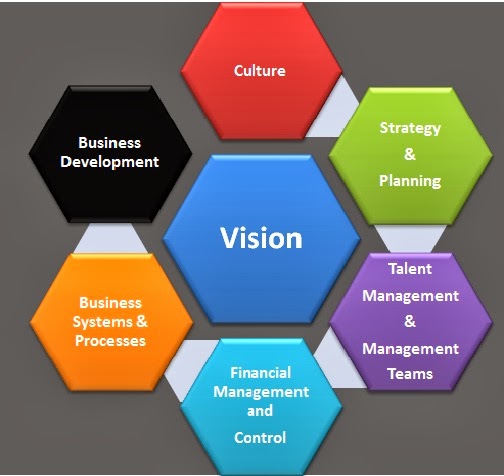
Secondly, it requires a very broad range of business knowledge and expertise. Its something that few business owners are aware of, especially in the early stages when often they are struggling to make the mind shift from being an exponent of what they do to being the MD of a business that provides those products or services  Even if they are aware of it few business owners have thought about managing the impact of growth or assessing the interconnections between functions which accentuate both good and bad decisions. I've put them into seven areas. They are:

Vision, Culture, Strategy and Planning, Talent Management, Financial Management & Control, Business Processes and Business Development. The first are about leadership and infrastructure. The other 5 look at key business activities but will be much more effective if the infrastructure is in place. 

The challenge for a business in maintaining high growth is to grow the organisation consistently over time to match sales. In supporting businesses to understand and undertake this challenge in a knowledgeable way we are much more like to provide sustainable high growth businesses. 

Exigent Consulting provides specialist services to the Small and Medium Business including Managing High GrowthBusiness Turnaround, and Mentoring. We help business owners improve the profit performance of their business.